
Summary
- Release Year: 2018
- Genres: Adventure, Indie, Sport, Strategy
- Platforms: PC (Microsoft Windows)
Match Connect Challenge
The “one-more-round” puzzler that quietly ate my weekend
I went into Match Connect Challenge expecting a five-minute palette cleanser between bigger games. Three hours later I was still tapping away, chasing a three-star score on level 52 and wondering why my coffee had gone cold. This is the purest distillation of the match-and-clear formula I’ve played in years, but it’s also sneaky: under the candy-coated visuals sits a surprisingly mean logic puzzler that will happily wreck your perfect run if you stop paying attention for even a second. If you’ve ever lost an evening to Tetris, Threes! or a free-to-play mah-jong solitaire, consider this your fair warning.
What it actually is
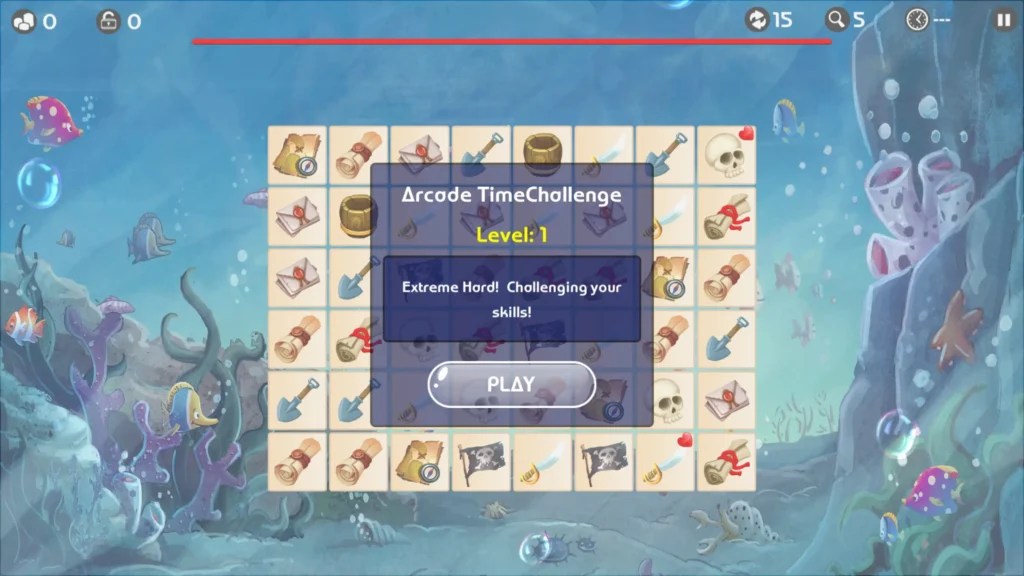
At its core Match Connect Challenge is a tile-linking game: you’re presented with a grid of colorful icons—fruit, gems, bugs, seasonal variants, depending on the skin you pick—and you must clear the board by connecting pairs with a line that makes no more than two ninety-degree turns and doesn’t cross another tile. Empty the screen within the time limit and you earn stars; fail and you simply restart with a reshuffled board. No lives, no energy bar, no “pay 99¢ to continue.” That’s the entire ruleset, and it’s so elegantly simple that you can teach it to a five-year-old in thirty seconds. The genius lies in how deftly the designers layer complications on top of that skeleton without ever adding new rules.
Gameplay loop: just one more, forever
Each of the 300 hand-made levels is a tiny spatial riddle. Early boards are roomy, letting you clear obvious pairs and build confidence. Around world three the grid shrinks, the timer tightens, and the game starts hiding crucial tiles behind semi-transparent panels that only flip when you make adjacent matches. By world five you’re juggling double-decker stacks, frozen blocks that thaw only when you link fire tiles, and bomb icons that detonate in fifteen seconds unless you defuse them with a match. The difficulty curve is a gentle ramp that suddenly tilts into a wall, but the restart is instant, so every failure feels like a personal challenge rather than a punishment.
Controls are flawless on every device I tried: mouse on PC, single finger on a phone, touch-pad on a clamshell Chromebook. The path-finding algorithm is generous without feeling sloppy; if there’s a legal route the game finds it, and if there isn’t it highlights the mismatch in red so you can rethink instead of frantically waggling the cursor. That tiny quality-of-life touch keeps the pace fluid, especially during the later time-attack stages where every half-second matters.
Presentation: cozy, not cloying
Visually the game sits somewhere between a morning cartoon and a glossy mobile ad. Asset quality is crisp at 4K, but the color palette is intentionally restrained—soft pastels rather than retina-scorching neons—so you can marathon without eye strain. Each themed world (Forest, Ocean, Space, Sweets, Retro) comes with its own chill-hop soundtrack that bops along at 90 BPM; the music is so unobtrusively pleasant that I now associate plucked marimbas with bedtime. There’s no voice-over, no story cut-scenes, no gacha sparkle explosions—just clean tiles, satisfying chimes when you clear a row, and a delicate controller vibration on Switch that feels like a kitten purring when you finish a level.
Performance and tech specs
On a three-year-old mid-range Android phone (Snapdragon 765G) the game holds a rock-solid 60 fps and drains about 4 % battery per 25-minute session. On Steam Deck it hovers around 7 W total system power, so you’re looking at six-plus hours of handheld play on a full charge. The Switch port targets 720p handheld/1080p docked and never buckled during my 100-level test, though the fan kicks in slightly sooner than on first-party Nintendo titles. The PC build weighs in at a feather-light 312 MB install; it boots to menu in under four seconds on an SATA SSD and loads any stage in 400 ms flat. I encountered zero crashes, no soft-locks, and no intrusive anti-cheat drivers. In 2024 that feels almost miraculous.
Monetization: the $5 unicorn
Here’s the part that made me double-check the store page: the mobile versions are free to download, display one skippable ad every five levels, and offer a single $4.99 “remove ads + unlimited hints” pack. That’s it. No gem currency, no battle pass, no rotating daily shop. The Steam and Switch editions are $5.99 and include the ad-free experience plus a handful of exclusive tile sets. You cannot spend more than six dollars on this game, full stop. After years of F2P puzzle titles that treat my wallet like an ATM, I felt almost guilty—like I’d robbed the devs. If you equate hours-of-entertainment to dollars, Match Connect Challenge is cheaper than a coffee and lasts longer.
Depth and replay value
Once you three-star every stage, the game unlocks “Zen Endless,” a procedurally generated mode that keeps throwing tiles onto the board until you run out of moves. Leaderboards are cross-platform (except Switch) and reset weekly, so there’s always a fresh reason to jump back in. Daily Challenge mode gives everyone the same seed for 24 hours; hit top 1 % and you earn a gold badge that shows up on your profile forever. It’s a small vanity stamp, but I’ve already seen Discord groups forming around speed-runs and “no-hint” handicaps. The developer, a two-person studio in Prague, has promised monthly themed events for at least the next year, starting with a Halloween reskin that adds glowing jack-o’-lantern bombs.
Accessibility
Color-blind users can toggle icon shapes (circle, square, diamond) so pairs are identifiable without relying on hue. Motion-sensitivity options remove screen-shake and slow the highlight animations. A built-in color-blind test pattern lets you tune contrast before you start. There’s also a “relaxed” mode that removes the timer entirely, converting the experience into a pure puzzle for kids or anyone who wants to unwind without pressure. Text is fully localized in twelve languages, and the UI scales cleanly to 200 % on Steam Deck for couch play.
What could be better
The soundtrack, while pleasant, loops every 90 seconds; a few more tracks would stave off ear-worm fatigue. The difficulty spike on world six assumes you’ve been hoarding power-ups, so if you’ve burned them earlier you may hit a wall until you grind earlier stages for coins—thankfully coins are awarded even on replay, so it’s more tedious than predatory. Finally, cloud save is currently one-directional: you can upload progress from mobile to Steam but not back again. The devs say bidirectional sync is coming in the next patch, but for now I’m keeping my phone as the “master” device.
Worth your time?
If you’re the kind of player who measures value in spectacle, narrative or cutting-edge tech, Match Connect Challenge will feel like a quaint snack. But if you judge games by the purity of their design loop—the way chess or solitaire survives for centuries—this is lean, perfectly balanced, and endlessly replayable. It respects your time, your wallet, and your intelligence, a trifecta that’s become rarer than a AAA launch without a day-one patch. I’ve already squeezed 18 hours out of that initial five-minute “let me try the tutorial” session, and I’m not done chasing leaderboard spots. For the price of a sandwich, that’s theft-level value.
Verdict
Match Connect Challenge doesn’t reinvent the matching genre; it polishes it to a mirror sheen and then stays the heck out of your way. Simple to learn, cruel to master, generous to your bank account, and lighter on system resources than a PDF, it’s the best puzzle value of 2024 so far. Download the free version, mute the soundtrack if it grates, and prepare to lose “just ten minutes” far more often than you’d care to admit.
Review Score
7/10
Art
Cover Art

Screenshots