
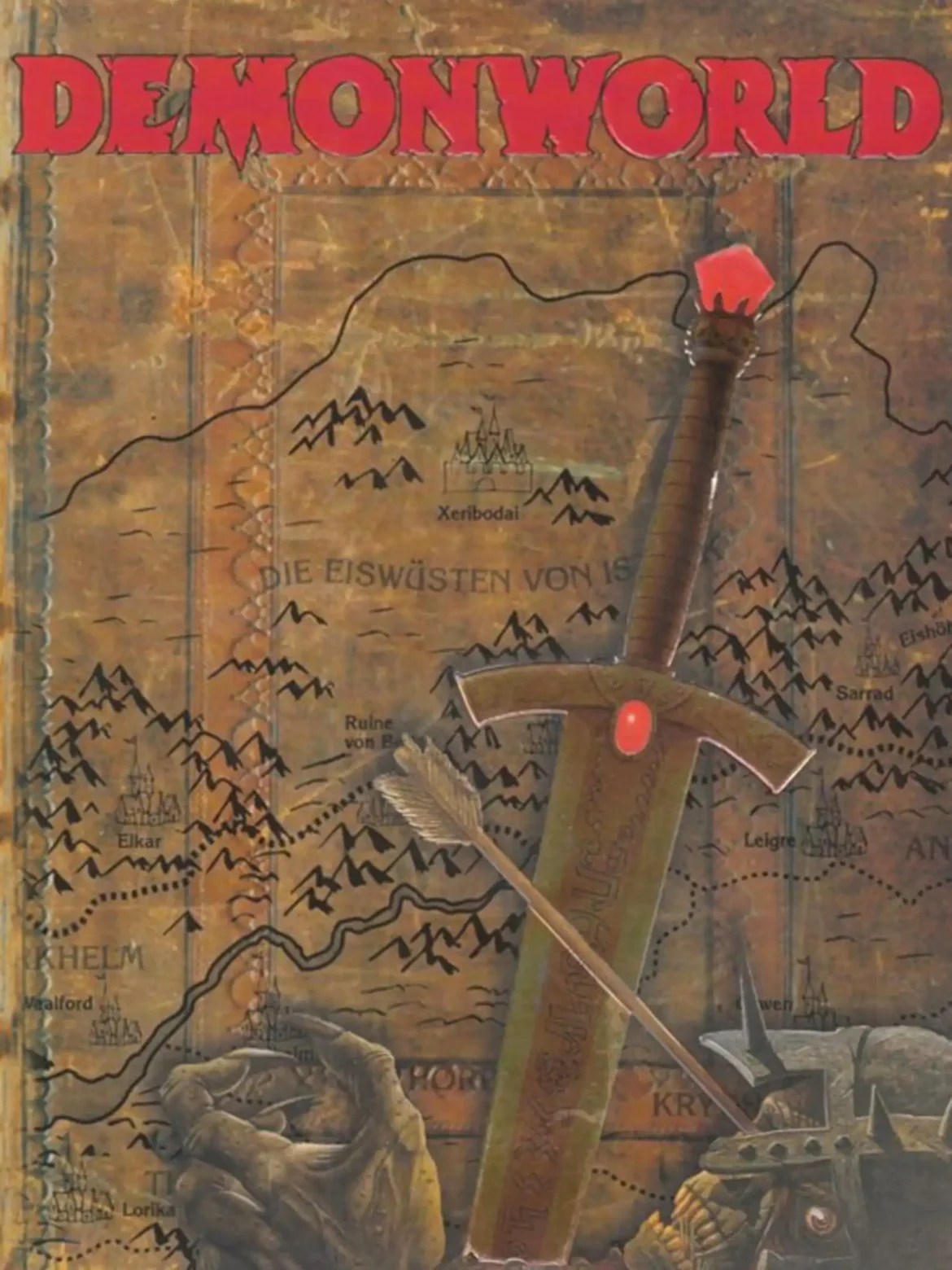
Summary
- Release Year: 1997
- Genres: Role-playing game (RPG)
- Platforms: DOS
- Developers: Ikarion
- Publishers: Ikarion
Demonworld is one of those buried-treasure PC titles that only the most dedicated grognards still whisper about in forum threads. Released in 1996 by the German board-game studio Hobby Products, it was the first—and, for decades, only—attempt to translate the tabletop wargame of the same name into bytes and pixels. If you missed it back then, you can be forgiven: the game launched with next to no marketing outside continental Europe, ran only in MS-DOS or under Windows 95’s shaky 16-bit compatibility layer, and arrived in an era when real-time strategy was about to steal the strategic spotlight. Nearly thirty years on, does Demonworld still deserve a slot on your retro playlist, or is it better left as a footnote in strategy-game history? Let’s march into the hexes and find out.
A WORLD SPLIT IN TWO
Demonworld’s premise is refreshingly binary: a medieval-fantasy continent is being torn apart by a demonic incursion, and you pick a side—mortal Humans or the infernal Demon hordes. There are no diplomatic niceties, no tech trees that span epochs, and no city builders tucked between battles. Every scenario is a stand-up fight on a hand-crafted map, and the campaign is simply a chain of these skirmies connected by brief text interludes. If you’re looking for Total War-style empire management, keep walking. If you crave focused, warband-level tactics, pull up a chair.
The single-player package is split into two separate campaigns (Human and Demon), each 12 missions long. They mirror one another geographically but not tactically: Human forces rely on combined-arms—spear walls protecting fragile archers, knights ready to flank—while Demons field monstrous bruisers, flying nightmares, and area-of-effect spellcasters. Difficulty ramps up by giving the AI more units, not smarter scripts, so expect to be out-numbered rather than out-generalled in later maps. A standalone scenario generator and a two-player hot-seat mode round out the offerings. Multiplayer over TCP/IP was promised on the box, but the feature never shipped; a patch added modem and serial-link support, but good luck making those work in 2024 without a serial-to-USB prayer.
GAMEPLAY: HEXES, HAMMERS, AND HOLY WATER
At first glance Demonworld feels like a spiritual ancestor to later tactical gems such as Battle for Wesnoth or The Battle Brothers. Each unit is a stack of up to 20 miniatures represented by a single sprite. The board is divided into neat hexes, and every turn you issue move-and-fire orders, cast spells, and watch the AI respond in kind. Combat resolution is deterministic—no dice rolls mid-battle—so outcomes hinge entirely on positioning, facing, and the rock-paper-scissors relationship between unit types. Cavalry charges devastate exposed archers; pike formations negate cavalry bonus; demons shrug off arrows but crumple under blessed weapons. Once you internalize the matrix, battles become a puzzle of angles and timing rather than luck.
The ruleset is deeper than the 1996 UI suggests. Flanking, morale, fatigue, supply lines for ammo, even elevation modifiers all factor in, but the game never tutors you. Expect to spend your first evening alt-tabbing to the manual (included in the GOG re-release) or squinting at a scanned PDF. Veterans of the tabletop version will feel at home; newcomers may bounce off the opacity. A single mid-campaign mission can take 45–90 minutes, and because there’s no mid-battle save, a bad match-up can cost you an hour of progress. That sounds brutal, but it also injects real tension into every hex you give up or claim.
CAMPAIGNS AND STORY: LORE IN THE MARGINS
Story beats arrive as parchment-text briefings voiced by a single narrator whose English dub veers into “Ikea instruction manual” territory. Still, the writers managed to sneak in some grimdark flavor: villages burning on the horizon, desperate last stands on broken ramparts, demons tempting mortals with Faustian bargains. The Human campaign plays like a traditional heroic journey, while the Demon path revels in conquest and corruption. Neither side gets character development beyond unit portraits, but the missions themselves tell micro-stories: escorting a supply wagon through haunted woods, holding a mountain pass until dawn, surviving a night assault on a ruined temple. It’s bare-bones, yet it works if you bring a little imagination to the table.
Replay value hinges on difficulty settings and the standalone scenario generator. Higher tiers give the AI more elite units and reduce your gold allowance, forcing you to experiment with cheaper troops and clever positioning. Sadly, the map editor never made it into the final build, so you’re stuck with the 24 handcrafted missions plus a random skirmish option that simply remixes starting forces on existing maps. Finishing both campaigns clocks in around 20–25 hours—respectable for a 1996 wargame—and the hot-seat mode can stretch that if you have a like-minded friend.
GRAPHICS AND AUDIO: DOS-ERA CHARM
Visually, Demonworld sits in that awkward but endearing mid-90s VGA era: chunky isometric tiles, dithered shadows, and palette-swapped sprites. Unit art is surprisingly detailed—human knights carry heater shields emblazoned with heraldic crests, while greater demons sport animated flame auras. Spell effects are limited to palette-cycling explosions and a flickering sprite or two, yet they land with a satisfying crunch thanks to crunchy 8-bit sound effects. The MIDI soundtrack is moody but loops every 90 seconds; after a three-hour session you’ll either mute it or learn to love the ear-worm motif. One neat touch: the battlefield darkens in real time to reflect the “hours remaining” timer in night missions, a subtle trick that still impresses.
PERFORMANCE, COMPATIBILITY, AND MODERN FIXES
Running natively on modern Windows is impossible—Demonworld is a 16-bit real-mode executable—but the GOG and Abandonia re-releases bundle it with DOSBox pre-configured. On a Ryzen 5 or M-series Mac the game boots in seconds, and cycles are plentiful enough to crank the emulated CPU to 50 k cycles, eliminating the original’s AI turn lag. Save files are tiny (a few KB), so cloud-syncing via Dropbox works fine if you want your campaigns on every PC. There is no widescreen patch; the viewport is locked at 640×480 in a 4:3 frame, but pixel-scaling shaders in DOSBox make it look crisp on 1080p and 1440p monitors. Controller support? Forget it. Mouse and keyboard or bust.
WHAT AGES WELL—AND WHAT DOESN’T
Good:
- Clear tactical depth with deterministic combat
- Two asymmetric factions that genuinely feel different
- Mission variety—holdouts, escorts, breakthroughs—keeps campaigns fresh
- Excellent paper-manual lore and unit art (if you own the boxed copy)
- Hot-seat multiplayer still works for couch generals
Not so good:
- No mid-battle save; a crash or phone call can wipe an hour
- AI is reactive, not strategic; higher difficulty just means more enemy HP
- Interface lacks tooltips; you’ll memorize weapon tables or perish
- Random skirmish generator is bare-bones compared to today’s roguelite standards
- Campaign story is skeletal even by 1996 expectations
COMPARISON: WHERE DOES IT FIT IN HISTORY?
Think of Demonworld as a bridge between 1994’s Warlords and 1997’s Final Fantasy Tactics. It lacks the RPG layer of the latter and the empire builder of the former, but its hex fidelity and deterministic combat prefigure the design ethos of later indie tactics titles. If you enjoy Battle Brothers’ mercenary management or Wesnoth’s campaigns, you’ll recognize the DNA. Conversely, if your sweet spot is Total War’s spectacle or XCOM’s cinematic flair, Demonworld will feel like watching chess pieces scoot across a bitmap.
PRICING AND AVAILABILITY IN 2024
Physical copies on eBay hover around €15–€25 for a boxed German edition; English boxes are rarer and fetch €40-plus. GOG sells the DRM-free digital release for $5.99, often discounted to $1.49 during seasonal sales. That’s cheaper than a cup of coffee for 20-plus hours of tactical noodling, so value is sky-high if the concept hooks you.
SHOULD YOU PLAY DEMONWORLD TODAY?
Ask yourself three questions:
- Do you enjoy turn-based tactics where positioning trumps RNG?
- Can you forgive a 90s UI that never heard of right-click tooltips?
- Are you curious about the evolutionary path that led to modern indie strategy?
If you answered “yes” to at least two, Demonworld is worth the tiny buy-in. It won’t consume your life like Civ VI or keep you glued to an online ladder, but it will scratch that “just one more turn” itch in short, brutal bursts. Fire it up on a laptop during a long flight, and you’ll be surprised how quickly the hours evaporate as you try to hold that last bridge against a horde of greater demons with nothing but a shaken spear unit and a mage who’s down to his final fireball.
For everyone else—especially players who value narrative production, modern QoL features, or multiplayer matchmaking—Demonworld is best sampled as a historical curiosity. Load DOSBox, peek at the manual, play the first two campaign missions, and you’ll have seen 80% of what it has to offer. That’s still more education than most gaming museums provide for the price of a sandwich.
VERDICT
Demonworld is a lean, focused wargame that nails core tactics but never quite evolves into the epic it wants to be. Its greatest strengths—deterministic combat, asymmetric factions, and scenario variety—are offset by AI limitations, sparse storytelling, and the absence of modern conveniences like mid-battle saves. Yet the package remains charmingly compact, and at current digital prices it’s one of the cheapest ways to sample 90s-era hex warfare without hunting down floppies or deciphering copy-protection wheels. Approach it with the right expectations, and Demonworld still has a few hot coals left to burn. Approach it expecting Total War grandeur, and you’ll trudge away singed and disappointed. For retro tacticians and strategy archaeologists, it earns a solid 6.5 out of 10—an intriguing artifact that deserves a spot on your retro hard drive, if not quite a throne in your pantheon of all-time greats.
Review Score
6.5/10