
Summary
- Release Year: 2018
- Genres: Adventure, Indie, Role-playing game (RPG)
- Platforms: Linux, Mac, PC (Microsoft Windows)
- Developers: Hosted Games
- Publishers: Hosted Games
Community College Hero: Knowledge is Power – the second semester for everyone’s favorite underdog super-students – doesn’t look like a blockbuster on paper. It’s a 250,000-word ChoiceScript text adventure, runs in any web browser, and costs less than a large pizza. Yet within five minutes you’ll be juggling study groups, overdue rent, a best friend who can level city blocks, and a new villain who literally eats superpowers for breakfast. If you loved the first game for its snappy dialogue and “community-college-with-capes” authenticity, Knowledge is Power turns the dial past eleven: tougher moral choices, higher stakes, and a branching script so reactive you can finish finals week with every teammate expelled, your secret identity sold to the tabloids, and the campus reduced to smoking rubble—all in a single playthrough.
Story & Writing: Text That Punches Above Its Weight
The game picks up one week after the events of Community College Hero: Trial by Fire. You’re still the only “zero” (a student with no powers) at the nation’s most budget-strapped superhero program, but now the media knows your name, the upperclassmen want you gone, and a mysterious syndicate called the Shadowy Government-Corporate Conspiracy (yes, that’s the official acronym) has planted a mole in your class. Author Eric Moser channels every ounce of classic Spider-Man drama: late-night cramming, ramen budgets, and the terror of seeing your tuition bill, except here a single wrong answer on a mid-term can accidentally trigger a city-wide gang war.
What separates Knowledge is Power from most visual novels is how aggressively the story pivots around your build. Play as a charismatic class president and you’ll spend more time politicking in the student lounge than punching thugs. Roll a stealthy infiltrator and you’ll burgle the dean’s office for blackmail material instead of writing a term paper. The script remembers everything—who you took to the fall dance, whether you snitched on a cheating roommate, even the brand of pizza you ordered during movie night—and pays it off in the finale with a level of reactivity most AAA RPGs would envy. My first completion clocked in at 11 hours, ended with two romances intact, one arm in a cast, and a campus on indefinite lockdown. My second, 9 hours, saw me expelled but hailed as a folk hero on social media. Both felt like canon endings.
Gameplay: Stats, Strategy, and Stress-Eating
The core loop hasn’t changed: you pick a weekly schedule balancing study, social life, training, and part-time jobs, then watch opposed stats like “Knowledge” vs “Courage” shift like tug-of-war ropes. New to Knowledge is the “Power” stat, a separate resource that represents your growing influence on campus. Spend it to blackmail professors, stage protests, or fast-track your application for the elite hero internship. The catch? Every Power play raises Suspicion, and once that meter maxes out the mole assassinates a classmate—permanently. After my first death I genuinely shut the laptop and walked away; the game had made me care about a pixelated side character with nothing but witty banter and a portrait frame.
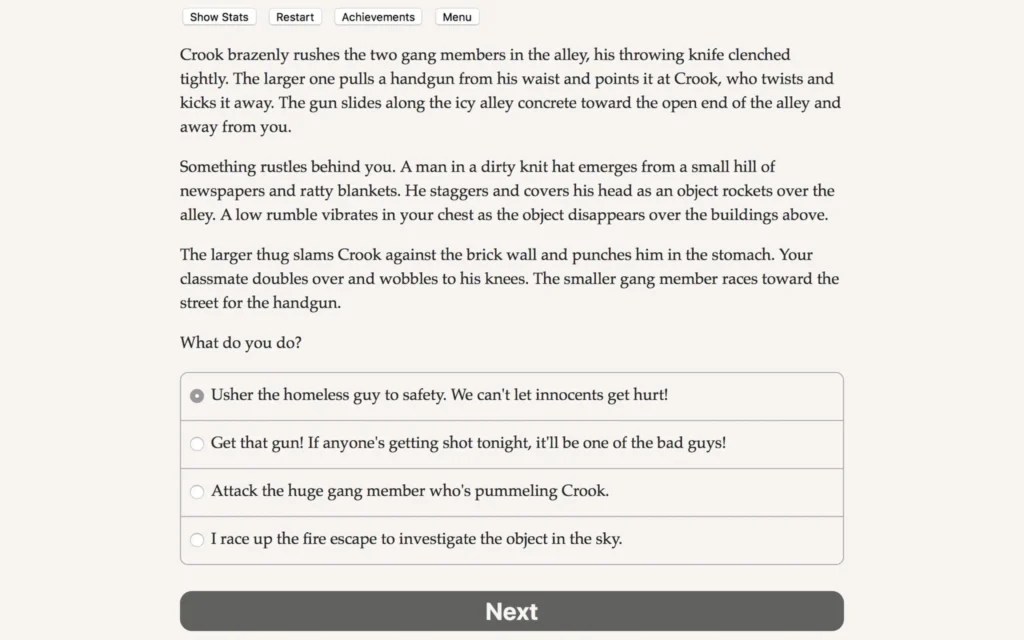
Combat encounters are still text-based, but Moser has added a “Team Tactics” layer. Before each mission you slot classmates into Striker, Defender, or Support roles, then pick maneuvers from a shared pool. The system feels like a lightweight XCOM: positioning matters, combos exist, and a badly timed taunt can leave your entire squad stunned. Because every teammate can also die, victory often tastes like guilt: I cheered when we curb-stomped the supervillain Sandblaster, only to realize my reckless orders put my love interest in the hospital for the rest of the term.
Romance & Relationships: More Than Side Quests
There are six full romance paths (three returning LIs, three new) and every one of them intersects with the central conspiracy. Date Stunner, the telepathic cheerleader, and you’ll learn to guard your thoughts during late-night cram sessions. Pursue the grumpy RA with ice powers and you’ll uncover a cold-case murder tied to the dean. The writing avoids trope traps: conversations feel authentically messy—awkward silences, emoji-laden texts, and the occasional “I need space” when mid-terms hit. Even better, the game doesn’t penalize you for staying single; platonic routes unlock unique team-up abilities like coordinated study sessions that boost everyone’s GPA.
Presentation: Words Are the Graphics
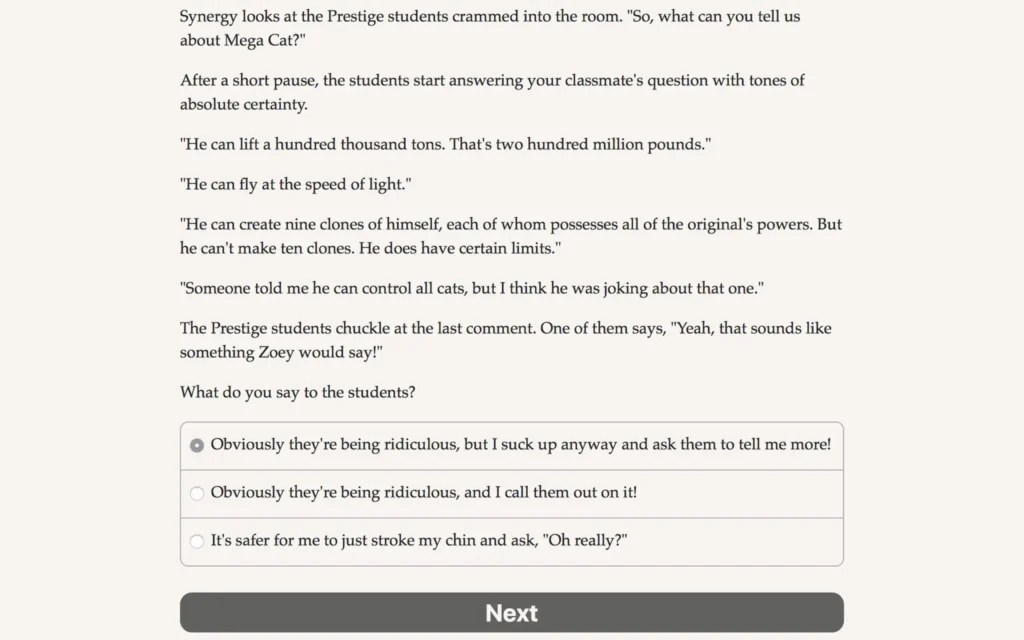
Let’s be honest: if you need ray-traced capes, look elsewhere. Knowledge is Power uses static character cards and a handful of backgrounds, but Moser’s prose carries the show. A rooftop confrontation with the villain Verdict is described with such cinematic precision—wind whipping capes into snapping flags, distant police sirens dopplering below—that I forgot there were no cut-scenes. The soundtrack (a $3 optional DLC) adds lo-fi beats that reminded me of studying in undergrad, but even on mute the writing alone evokes mood: the fluorescent dread of a 24-hour library, the metallic tang of blood after a hallway brawl, the weird serenity of floating three inches above your dorm bed the first time you manifest latent powers.
Performance & Accessibility: Runs on a Potato
Being pure HTML and JavaScript, the game loads instantly on any browser, cloud-saves to Google, and is fully screen-reader friendly. Font size, background color, and animation speed can be tweaked on the fly. On my ancient Chromebook it never dipped below 60 fps—because, well, text. Achievement hunters get 57 Steam cheevos, half of them hidden behind obscure choice combinations like “Order pineapple pizza while romancing the journalism major and maintaining a 3.8 GPA.”
Replay Value: The Real Final Exam
Officially there are four main epilogues (Hero, Villain, Rogue, Civilian) but the variations within each are staggering. The game tracks 27 different variables—from whether the campus food truck survives to whether your mom learns your secret identity—and every ending slide changes accordingly. I’ve finished four runs and the achievement list claims I’ve seen 42% of the total content. A “New Game+” option lets you carry over relationship points and one stat maxed at 80, so subsequent attempts feel like speed-running rather than retreading. Even failed runs unlock vignettes: my shortest game ended at hour three with my character in federal custody, yet that route revealed the conspiracy’s mole in a twist I never saw coming.
Pricing & Value: Scholarship-Level Cheap
At $7.99 full price (frequently discounted to $4.99), Knowledge is Power offers more word-count than most fantasy door-stoppers and more branching than many $60 RPGs. The first game is bundled for another $4.99, so twenty bucks gets you two semesters and roughly 25 hours of top-tier interactive fiction. There are no micro-transactions, no season passes, just a single tip-jar button that lets you buy the author a coffee. I chipped in another five bucks after my second completion; I’d spent more on vending-machine coffee during a single play session.
Criticisms: Not Every Power Shines
For all its ambition, the middle third can feel like syllabus bloat. Because every teammate can die, certain scenes must work with any combination of survivors, leading to occasional placeholder dialogue that repeats word-for-word. The new “Research” mechanic—where you sink weeks into crafting gadgets—is undercooked; my homemade taser never felt stronger than any classmate’s innate abilities. And while the mystery plot is gripping, the reveal of the mole relies on knowledge checks that can be failed, meaning some players will reach the finale still unsure who betrayed them. A post-game “codex” would have been welcome.
Verdict: Ace the Course
Community College Hero: Knowledge is Power is the rare sequel that respects your save file, your choices, and your intelligence. It’s a coming-of-age story about tuition debt, found family, and the terror of realizing your professors are more messed-up than you are. It made me laugh aloud when my sidekick misquoted Batman, rage-quit when a dice roll killed my favorite teammate, and genuinely reflect on whether doing the right thing is worth being hated. If you believe superhero stories are at their best when they’re about people, not powers, enroll immediately. Final grade: 8.5/10—honor-roll material, with extra credit for heart.
Review Score
8.5/10
Art
Cover Art

Screenshots