
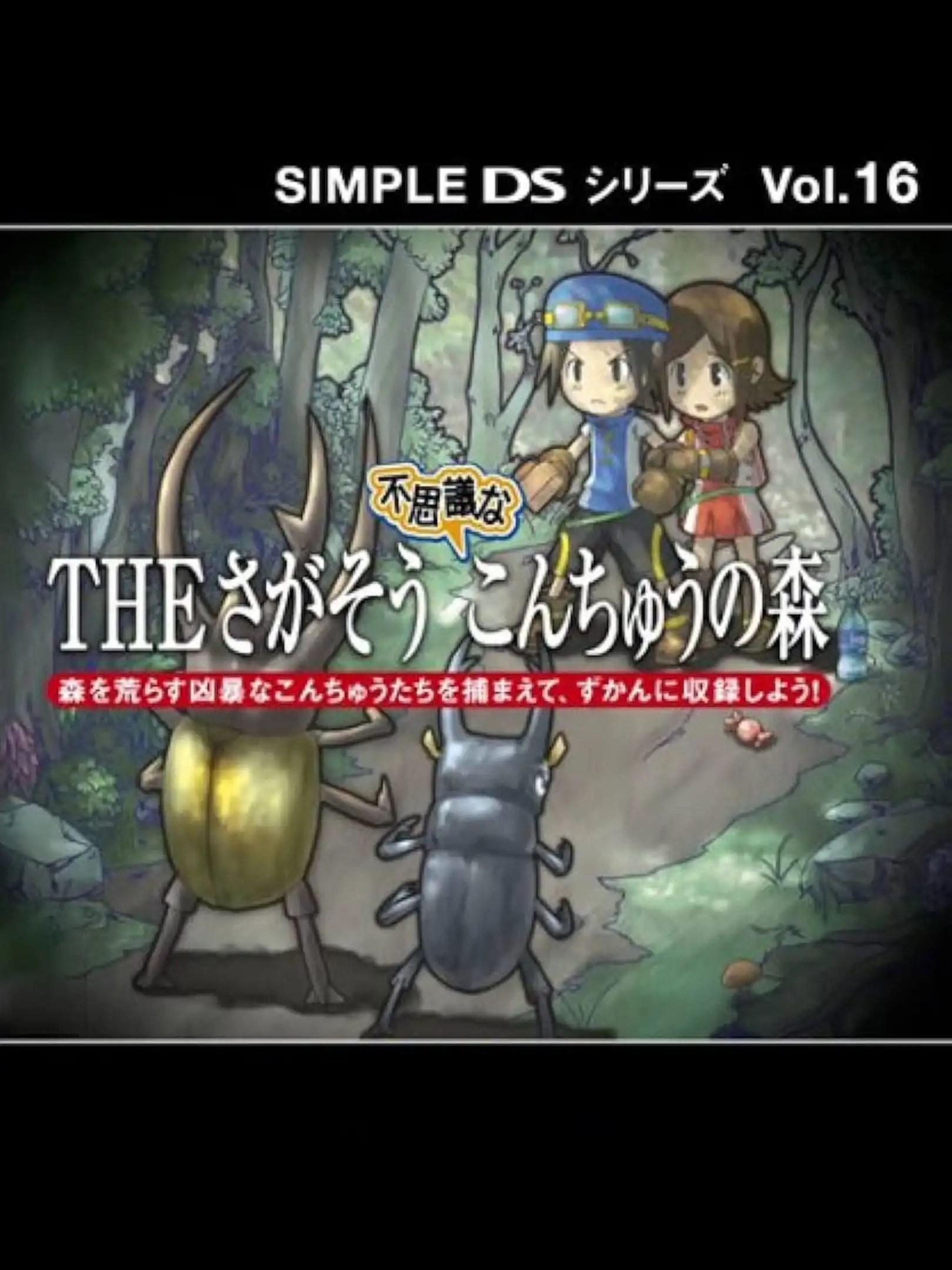
Summary
- Release Year: 2007
- Genres: Role-playing game (RPG)
- Platforms: Nintendo DS
- Developers: DreamFactory
- Publishers: D3Publisher
Simple DS Series Vol.16: The Sagasou – Fushigi na Konchuu no Mori
(“Let’s Collect: The Mysterious Insect Forest”) never left Japan, and that’s a shame—because tucked inside this unassuming budget cartridge is one of the most relaxing, low-stakes “life-sims” the Nintendo DS ever received. It won’t change your world, but if you’ve ever lost an afternoon to bug hunting in Animal Crossing or spent hours perfecting your beetle collection in Pokémon, this forgotten little curio might be your next import-flavored comfort food.
What it is
The Simple DS line was Japan’s answer to a $20 rack-filler: bite-sized games sold at supermarket kiosks and train-station convenience stores. Most of them are, frankly, shovelware. Sagasou, however, was developed by a small team at Jupiter Corporation—veterans who had already proven they could squeeze charm out of the DS hardware with titles like Picross DS. Rather than a mini-game compilation, Sagasou is a light RPG/bug-collection sim set in a storybook forest. You arrive as a silent protagonist armed with a single net, a sketchy field guide, and the dream of becoming the forest’s resident insect encyclopedia.
Core loop, minus the fat
Each in-game day lasts about 12 real-time minutes. You wander looping 2-D screens of forest, meadow, and riverbank tapping on anything that crawls, hops, or buzzes. When you tap, the game switches to a timing-based micro-game: a shrinking circle a la Pokémon GO, but with a satisfying “snap” haptic from the DS speaker when you land the net. Success nets (sorry) the bug; failure sends it scurrying off the touch screen. Bugs vary by time of day, weather, and season—rainy evenings bring out different beetles than sunny mornings, so there’s a gentle push to check back throughout the day.
Once caught, bugs are automatically pinned to your digital trophy room. You can rotate them 360°, zoom in, and read a short, kid-friendly description. Completing “sets” (all stag beetles, all butterflies, etc.) earns stamps that unlock new areas and, crucially, better nets with larger sweet-spots and shorter cooldowns. It’s a textbook dopamine drip, but Jupiter keeps the grind respectful: you’re never more than a couple of short sessions away from the next discovery.
A story, sort of
About 30 minutes in, you meet Piko, a talking firefly who claims the forest is “losing its colors.” From there you’ll collect six magical “Forest Fragments” by fulfilling small quests: deliver five honeycombs to the queen bee, photograph the rare rainbow moth, or escort a lost caterpillar home. None of it is voiced, but the Japanese text is elementary-school level; Google Translate’s camera function is usually enough to muddle through if you’re an importer. The plot is just scaffolding, but it nudges you toward 100% completion and adds stakes without the melodrama of a typical JRPG.
Progression that respects your time
There are 208 insects to catalog, but the game doles them out at a brisk clip. Early nets have a 50% success rate; the final gold net boosts it to 90%, and you’ll earn it after roughly four hours if you focus on quests. You can also craft lures using berries and tree sap to attract rare species, or plant flowers that function like passive traps—check back tomorrow and you’ll find new moths hovering around. It’s the kind of design that feels perfectly at home on a handheld: rewarding enough to boot up on the bus, but never so demanding that you resent putting it to sleep.
Presentation: storybook pixels
Graphically, Sagasou looks like a lost GBA game—tiny 16×16 sprites, parallax backgrounds, and a saturated color palette that pops on the original DS phat’s dimmer screen. The art direction is cohesive: every beetle sheen and butterfly wing shimmer is hand-drawn rather than 3-D modeled. When you open your collection, each insect is framed against a parchment backdrop with faux-handwritten labels. It’s not pushing polygons, but the personality lands harder than many technically superior DS titles.
Sound design is equally cozy. The forest hub loops a gentle, koto-and-flute melody that never overstays its welcome, while each habitat has its own ambient layer—croaking frogs near the pond, cicadas in the meadow. The net “thwack” is piped through the DS speaker in mono, but Jupiter uses a tiny reverb so it feels like you’re swinging in open air. Headphones recommended; the mix is subtle enough that you’ll miss nuances on the tinny built-in speakers.
Performance & tech
Running on a DS Lite, load times are non-existent—each area streams in under a second. Sleep-mode is instantaneous and stable; I left the cart idle for three days and resumed mid-catch with no battery drain spike. On 3DS via DS backward compatibility, the game scales cleanly and the circle-pad maps to the D-pad, but you’ll still need the stylus for catching. No DSi enhancements, no rumble pak support, no Wi-Fi features. That last point hurts: local trading would have been perfect, but the cartridge is entirely offline.
Replay value
After you beat the final boss—a surprisingly tricky quick-time sequence against a giant robotic bee—the post-game opens “Endless Season” mode. Weather and spawns now cycle randomly, and a new page of ultra-rare insects (think 1% encounter rate) appears. Completionists can easily double their hour count here, but even casual players can see the credits within six relaxed evenings. Because the cart saves directly to the ROM, you can reset and replay immediately; there are no permanent missables, so it’s stress-free for perfectionists.
Pricing & availability
Because it never released in the West, eBay is your best bet. Loose carts hover around $18–$25 USD; complete-in-box copies fetch $35–$45 depending on condition. That’s firmly in “impulse-buy” territory for import-friendly collectors, but remember: the entire game is in Japanese. If you can’t parse katakana, expect to lean on translation apps or fan guides. (The good news: menus use icons, and bug stats are mostly numbers.)
Worth it?
Sagasou isn’t a buried masterpiece—it’s a warm, low-calorie snack. If you adore critter-collecting but don’t want the stress of Pokémon’s competitive layer or the real-time commitment of Animal Crossing, this is the middle ground. The reward loop is tight, the art is charming, and the soundtrack will live rent-free in your head for weeks. On the flip side, if you need high-octane action, multiplayer, or English text, skip it. For everyone else, especially parents hunting a kid-safe import, Sagasou punches well above its budget weight.
Verdict
Simple DS Series Vol.16 won’t top anyone’s “best DS games” list, but it might sneak onto your “most relaxing” roster. It’s the gaming equivalent of flipping through a nature field guide with a cup of tea: pleasant, peaceful, and over before it wears out its welcome. At under thirty bucks, that’s a mystery worth exploring—even if you have to dust off your Japanese dictionary to do it.
Review Score
6.5/10
