
Summary
- Release Year: 2014
- Genres: Arcade, Platform
- Platforms: Nintendo Switch, PlayStation 4
- Developers: Konami
- Publishers: HAMSTER
Arcade Archives: Mr. Goemon
The 1986 coin-op that quietly invented “weird Japan” – and why it’s still a blast in 2024
Of all the legends orbiting the Japanese arcade golden age, Mr. Goemon is the one that never got its due in the West. Konami’s 1986 coin-op is the missing link between the side-scrolling run-’n-gun craze of Green Beret/Rush’n Attack and the absurdist samurai comedy the company would later perfect on Super Famicom with Ganbare Goemon 2. Hamster’s Arcade Archives release finally gives the rest of the world a friction-free way to experience it—no import board, no Super Famicom cartridge that costs more than a Switch OLED, no fiddling with MAME romsets. Thirty-eight years on, is it worth 7.99 of your modern-earth dollars? Short answer: if you have even a passing interest in arcade history, side-scrollers, or just want to see where all those giant robot cat-bikes in later Goemon games came from, absolutely. Long answer: read on.
-
What exactly is Mr. Goemon?
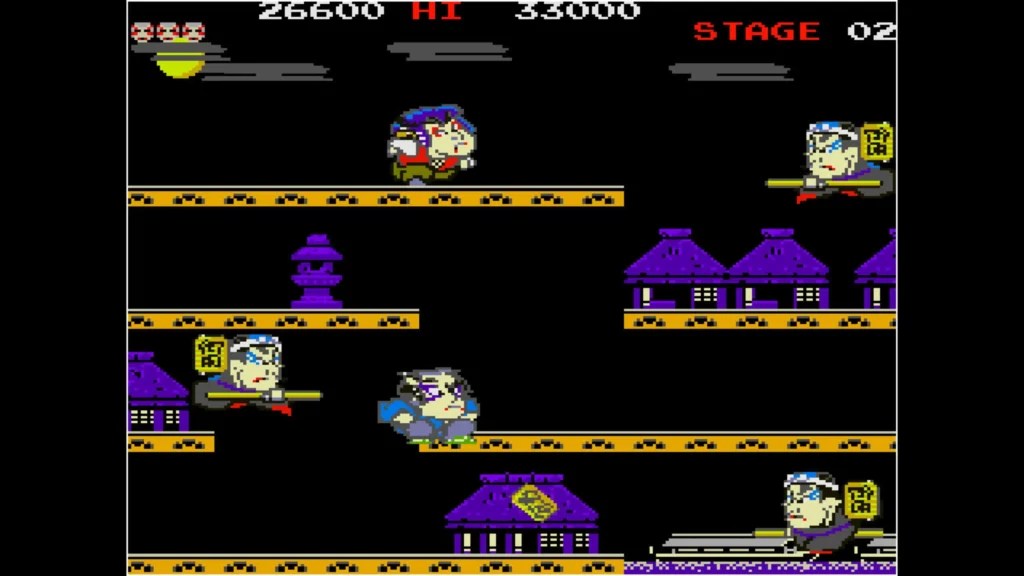
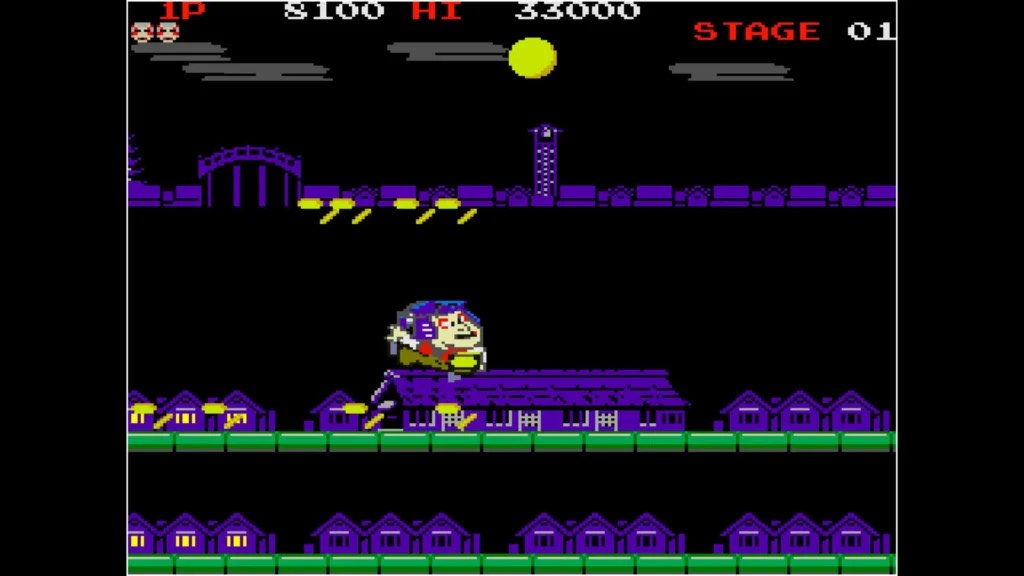
Imagine if Konami had made Super Mario Bros. in 1985, then immediately asked, “What if we set it in feudal Japan, gave the hero a pipe that turns into a flail, and replaced every goomba with a tanuki that throws exploding mochi?” That’s Mr. Goemon. You’re the titular chivalrous thief, jogging left-to-right (and sometimes right-to-left) across a hyper-stylized Edo, smashing guards, ninjas, and the occasional fire-breathing statue. Every third screen the game flips to a forced-scrolling “escape” stage where you surf on a wooden washtub dodging cannonballs. It’s half platformer, half reaction-test, 100 % Japanese arcade lunacy. -
The arcade-only black sheep
Western fans usually meet Goemon through Mystical Ninja on SNES or N64. Those games are RPGs full of fart jokes and giant mecha. The 1986 original is a pure coin muncher: seven short loops that get faster and nastier until you’re essentially playing a twitch shooter on legs. Konami never ported it to the Famicom, so it remained stranded in arcades and, later, rare Japanese Windows compilations. Until now the easiest way to play was the 1998 Konami Antiques MSX cart on Saturn—hardly ideal. Hamster’s reissue is the first time the game has ever been sold stand-alone outside Japan. -
Controls that feel weird—until they click
Goemon has two buttons: jump and attack. Tap attack and you swing a kiseru pipe that extends into a chain-whip. Hold attack and you get a longer-range poke, but you can’t move while the pipe is extended. That tiny hesitation is the heart of the game’s risk-reward. Enemies drop gold coins (score), rice balls (points plus health), and sandals (speed boost). Grab too many sandals and Goemon becomes so fast he’s uncontrollable—classic arcade trolling. The first loop is generous; by loop three you’re praying for rice balls because every hit subtracts a life and sends you back to a checkpoint. It’s tough but fair in the way 80s arcade games are when they want another 100-yen coin, not when they want to sell you DLC. -
Visuals: 8-bit ukiyo-e on steroids
Running on Konami’s early GX hardware (also used for Salamander), the game pushes 256-colour sprites that still look vibrant on a 4 K set. Backgrounds layer parallax rice fields, neon pachinko parlours, and castles silhouetted against setting suns. Enemy animation is cartoon-expressive: samurai blink in disbelief before exploding into cartoony bones, tanuki spin their testicles—uh, coin purses—before hurling bombs. Yes, it’s the same gag the later games kept. The Arcade Archives version lets you apply a tasteful scanline filter or blow the pixels up to full-screen 16:9 without the mud you’d get from a cheap scaler. Purists can stick to 4:3 with 54 Hz arcade refresh; speedrunners can force 60 Hz to eliminate the slight slowdown that happens when too many sprites crowd the line. -
Soundtrack: the earworm you’ve never heard
Because the Goemon IP is steeped in kabuki aesthetics, the music mixes shamisen riffs with Konami’s trademark bubble-gum synth. The main theme is basically “What if the Super Mario overworld were played on a taiko drum and a Commodore 64?” You’ll hum it for days. Hamster includes the optional high-quality Mister soundtrack (a PS5 exclusive toggle) that cleans up the PCM without losing the cheese. Plug in headphones and you’ll notice the percussion track uses the same PCM channel Konami later recycled for the laser sounds in Salamander—tiny bit of trivia to drop on your retro-podcast. -
Gameplay loops and scoring
A single credit lasts 15 minutes if you’re a savant; most players will see the continue screen in three. The scoring system rewards speed-killing enemies in succession, so chaining waves without taking damage becomes an obsession. Hamster adds two online leaderboards: one for “Arcade Rules” (no save states, default difficulty) and one for “Hi-Score” (anything goes). Being able to upload a 1.2 million run and watch the instant replay of the current world record is the kind of feature that turns a curiosity into a lifestyle. Don’t care about score? You can still brute-force the game with unlimited credits and see all seven loops in 40 minutes. Either way, you’re getting the full experience that cost Japanese kids a month’s allowance in ’86. -
Difficulty and modern assists
Hamster’s package is light on hand-holding but heavy on options. You can dial enemy speed down to 50 %, bump starting lives from 3 to 7, or enable a 30-second rewind that makes the last-second jump on Loop 4’s disappearing bridge trivial. Purists will turn everything off, but the assists are perfect for couch co-op passing the pad with friends who think “NES hard” is a myth. Trophy hunters on PlayStation get a platinum that pops after beating Loop 2 without continuing—tough but doable with practice and a little judicious rewinding. -
Replay value
Seven loops sounds short, but enemy patterns shuffle every cycle and the speed caps out at Loop 4. After that it’s essentially a caravan shooter on foot, perfect for ten-minute daily sessions. The inclusion of both Japanese and “World” ROMs is a nice touch: the World version removes the rice-ball power-ups and swaps the soundtrack order, so you’re essentially getting two slightly different games. Add online leaderboards, 40 unlockable wallpapers (hi-res flyers, instruction cards, sprite sheets), and the usual Hamster museum scans and you’ve got maybe 10–15 hours to clear both versions, months if you dive into scoring. -
Performance and tech notes
On PS5 the game runs at a locked 1080p/60 with the arcade’s native 224×256 output pillar-boxed. Load time is under three seconds; quick resume works flawlessly. Xbox Series S|X offers the same, plus Smart Delivery so your cloud save follows you to PC. Switch is, predictably, the least crisp in handheld mode—720p with slight shimmer on pixel edges—but still perfectly playable. Hamster’s emulation is cycle-accurate down to the original slowdown, so tool-assisted speedruns made on MAME won’t match this release, a deliberate choice to keep leaderboards clean. -
Price and value proposition
At US $7.99/€7.99/£6.49, Mr. Goemon sits in the middle of the Arcade Archives range. That’s the cost of a single continue in most modern arcade bars, and here you own the board forever. There’s no DLC, no season pass, no cosmetic pipe skins—just the full game, a bunch of sliders, and the promise that your high score will still be on the server next decade. Compared to Nintendo’s $7.99 NES reissues on Switch Online that you lose if you unsubscribe, Hamster’s model is refreshingly honest. -
Who should buy this?
- Retro devotees who collect every Hamster release (you know who you are).
- Fans of the later Goemon games who want to see where the aesthetic was born.
- Score-chasers looking for a new leaderboard to climb—right now the top spot is only 2.3 million, very achievable.
- Casual players who want a 30-minute blast of weird arcade history with a rewind button.
- Parents who’d rather their kids saw feudal Japan than another Fortnite skin (and yes, the game is rated E10+—the tanuki “pouch” joke is censored in the Western ROM).
-
Who can safely skip?
If your tolerance for 80s checkpoint design is zero, or you need 40-hour open worlds, Mr. Goemon will feel like a charming but expensive snack. Likewise, if you already own the Japanese Konami Arcade Collection on Saturn/PS1, you technically have this ROM—though without save states, leaderboards, or 4 K output. -
The bottom line
Arcade Archives: Mr. Goemon is the definitive way to play a game that history almost forgot. It’s fast, funny, eye-wateringly pretty in that early pixel-art way, and just deep enough to keep you coming back for “one more loop.” At eight bucks it’s a no-brainer for anyone who likes arcade culture, Japanese weirdness, or just wants to prove they can beat 1986 without a single rewind. Hamster continues its quiet mission to preserve the best coin-op classics, and Mr. Goemon deserves to sit in your Switch library right next to Metal Slug and Psycho Soldier. Go on—give the pipe-swinging thief a quarter. He’s been waiting 38 years to steal your afternoon.
Review Score
7/10
Art
Cover Art

Screenshots