
Summary
- Release Year: 2015
- Genres: Adventure, Puzzle
- Platforms: Android, iOS
- Developers: imagoFX
- Publishers: imagoFX
XON Episode Two – Desert Islands, Alien Relics, and the Sweet Agony of a Cliff-Hanger
There’s a moment, about 20 minutes into XON Episode Two, when you step through a crumbling stone arch and the camera tilts just enough to reveal a desert basin glittering with impossible machinery. No music swells, no NPC shouts exposition, and no quest log pops up to tell you what to do. Instead, the wind hisses across sandstone, a distant spire hums like a tuning fork, and you feel that delicious Myst-era tingle: “I shouldn’t be here, but I really want to figure out why I am.”
If that sensation sounds familiar, you already know whether this game is for you. Developer Yahknow Studios isn’t shy about its inspirations. Episode Two is the second bite-sized entry in a four-part mobile series that openly invites comparison to Cyan’s golden-age adventures. The difference is you’re playing on a phone that fits in your pocket, you can finish the whole thing in a single lazy afternoon, and it costs less than a fancy coffee. The question is whether that compact experience delivers the same lingering aftertaste as the classics it worships. After rolling credits—and immediately swiping to see if Episode Three was secretly live—I’d say it mostly does, with a few caveats big enough to drive a sand-crawler through.
A World You Can Spin With One Thumb
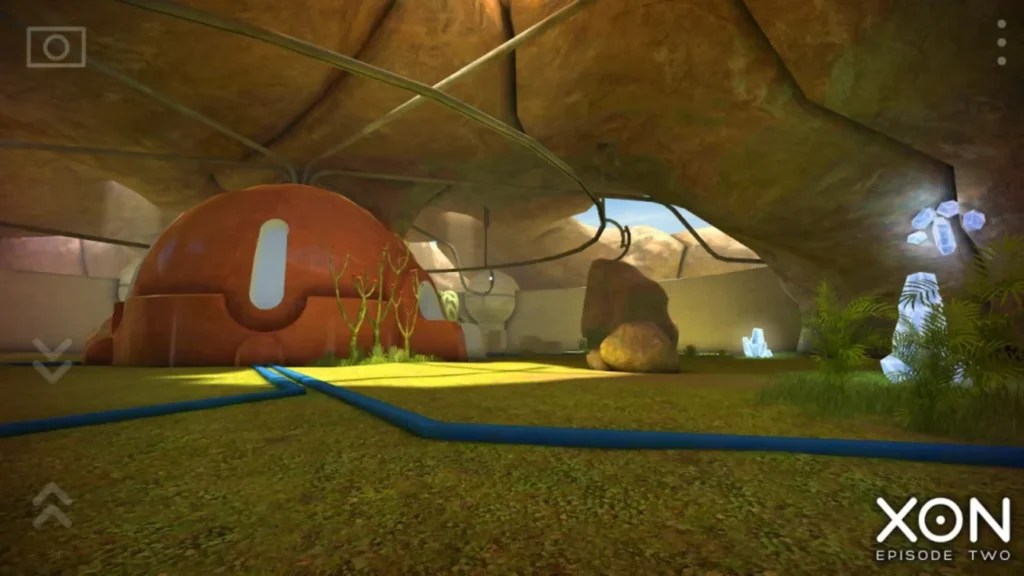
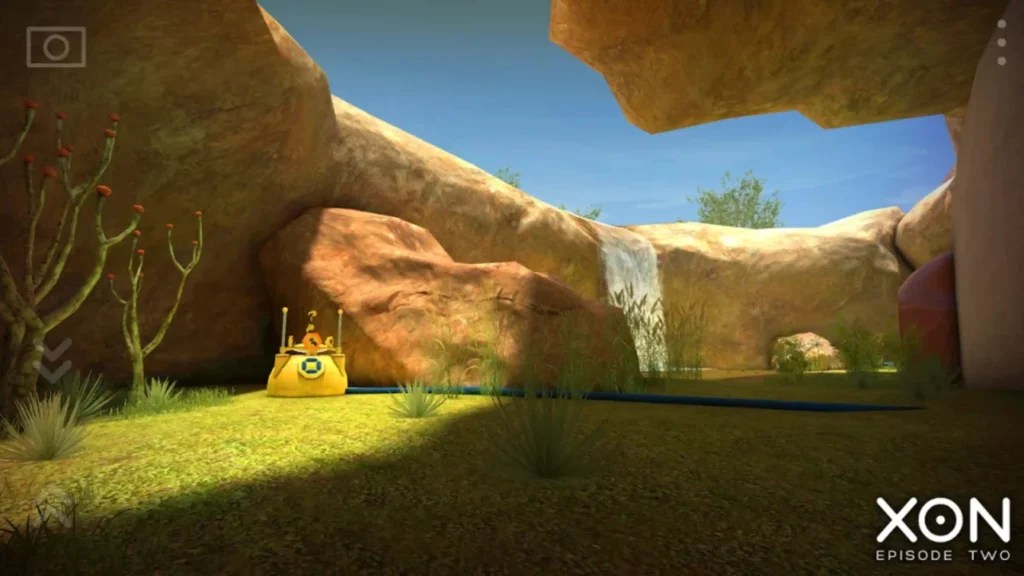
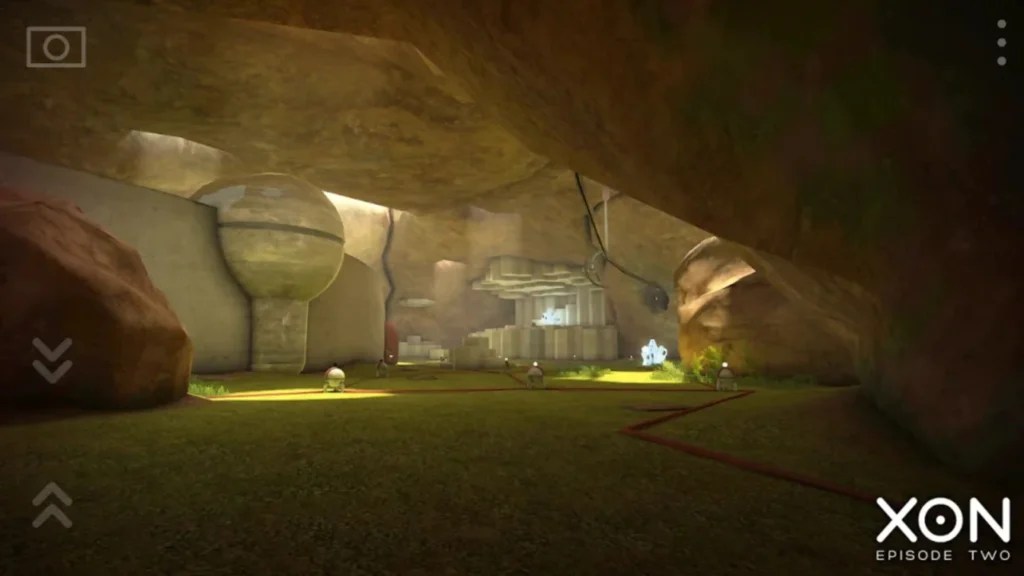
Let’s get the obvious out of the way: XON is gorgeous. Not “good for a mobile game” gorgeous—just flat-out gorgeous. Episode Two jumps from the cramped, mossy caverns of the first entry to a sun-scorched valley that looks like Monument Valley and Riven had a baby. Rock formations are carved with geometric glyphs that glow when you solve a puzzle. A half-buried ring of metal slowly rotates in the distance, hinting at some ancient power source. Every screen feels like a postcard you want to screenshot and crop into a phone wallpaper.
Controls are the usual mobile-adventure shorthand: drag to swivel the camera, tap nodes to move, pinch to zoom. It’s simple, but it works because the game never asks for reflexes—only attention. I played on a 2021 iPad Mini and a battered Pixel 4a; both maintained a locked 60 fps with only a single stutter when I solved the final sequence and the game auto-saved. On smaller phones you’ll do a lot of zoom-pinching to read glyphs, but the UI never crowds the view. Bonus points: no energy timers, no micro-transactions, no “share to unlock hints.” It’s premium in the best sense.
Puzzles: Old-School Logic, New-School Convenience
Episode Two contains nine major puzzles and a handful of smaller “align-the-symbols” locks. They range from classic slider conundrums to a genuinely clever sundial sequence that uses your device’s clock. (Don’t worry, night-shift players; there’s a manual override.) One standout tasks you with re-routing laser beams through rotating prisms, but the beams are actually shafts of sunlight, so the angle of the in-game sun changes the refraction. Watching the light shafts crawl across the sand as you spin a pedestal is the kind of “aha” moment that makes you nod at your phone like a proud parent.
Difficulty sits squarely in the middle of the Myst bell curve. Veterans will solve most in five-to-ten minutes, but newcomers might bang their head on the planetarium board that requires cross-referencing three constellations with a base-8 number system. If you get stuck, an optional hint layer slowly fades in interactable objects, but it never outright tells you the answer. I leaned on it once and still felt smart afterward—exactly what a hint system should do.
My only gripe: inventory puzzles are still MIA. Every solution is either a code, a switch sequence, or a physical manipulation in the world. That keeps the interface elegant, but it also means you’ll never combine a hook and rope to fish a key from a crevasse or any of the MacGyver antics that made Riven sing. Here, the world is the puzzle, not your backpack.
Story: Lore Fragments in the Sand
XON is allergic to exposition. You arrive via a portal from Episode One, find a journal page that basically says “Keep the machine running,” and spend the rest of your time piecing together who built these contraptions and why the desert is littered with half-functioning tech. Environmental storytelling is king: a mural of star charts, a rusted rover, a cracked hologram of a robed figure. If you want a plot that tells you who to root for, look elsewhere. If you like decoding alphabets and theorizing about ancient astronauts on Reddit, bring a notebook.
The bigger picture is starting to cohere across episodes. Symbols from Episode One reappear here, implying a cohesive alien language. A post-credits stinger shows a moon-sized sphere hovering over the desert, which ties into the journal’s cryptic warning about “convergence.” I’m hooked, but I’m also aware that the series could pull a Lost and never stick the landing. Until then, the mystery alone is fuel.
Length and Value: A Snack Plate, Not a Feast
Clocking in at roughly 90 minutes for puzzler pros and maybe two-and-a-half hours if you savor every vista, Episode Two is short even by mobile standards. The App Store asks $2.99 (with occasional $1.99 sales), which puts it at about two bucks per hour of content. Compare that to a movie rental and it’s a bargain; compare it to the 20-hour behemoth that is the Room series and it feels slight. The brevity wouldn’t sting if Episode Three were already out, but Yahknow has been radio-silent on a release window since 2020. Nothing kills momentum like a cliff-hanger you can’t binge past.
Replay value is minimal. You can hunt for 20 collectible glyphs scattered off the main path, and a speed-run achievement challenges you to finish in under 30 minutes, but there are no branching paths or hidden endings. I jumped back in, sprinted through in 28 minutes, felt briefly smug, and haven’t reopened it since. Achievement hunters will appreciate the Game Center integration; everyone else will probably delete and reinstall when (if) the saga concludes.
Audio Design: Silence, Then a Pulse
The soundscape deserves special praise. Most ambient tracks are barely above a whisper—wind, the crunch of sand, the soft clunk of stone rotating—so when a low synth pulse kicks in during the finale, it lands like a jump scare. Headphones are mandatory; phone speakers flatten the bass to a mosquito buzz. There’s no voice acting, but the alien contraptions emit satisfying mechanical chirps, like R2-D2 gargling marbles. Every interaction feels tactile, even though you’re only tapping glass.
Performance and Compatibility: Runs on a Potato, Looks Like a Console
I tested on four devices: iPad Mini 6 (A15), iPhone SE 2020 (A13), Pixel 4a (Snapdragon 730G), and a 2018 Samsung Galaxy Tab A (low-end). The iOS devices hit 60 fps at native resolution; the Pixel managed 60 with occasional dips to 52 when multiple light shafts overlaid; the elderly Galaxy Tab hovered around 30 fps but stayed playable. File size is a svelte 650 MB, so it downloads fast even on 4G. Cloud saves sync via Game Center or Google Play Games, letting me hop between phone and tablet seamlessly. No crashes, no soft-locks, no corrupted saves—an increasingly rare feat in 2023.
Accessibility: Almost There
Options include toggling motion blur, adjusting camera sensitivity, and remapping the left-handed interface. Color-blind players can switch glyph highlights from red/cyan to blue/yellow, but some puzzles still rely on hue differentiation. Text is resizable, but the journal font is deliberately grungy; I had to squint on a 5.4-inch screen. There’s no full voice-over or subtitles, because, well, nobody speaks. Overall, it’s more accommodating than the 90s classics, but not up to contemporary AAA standards.
The Verdict: A Gorgeous Teaser That Leaves You Hungry
XON Episode Two is the video-game equivalent of a short story you finish in one sitting, then flip to see if the author snuck in an extra chapter. It’s confident, restrained, and laser-focused on delivering one solid dose of atmospheric puzzling. The artistry on display could rival any big-budget indie if the series sticks the landing. But until Yahknow releases the remaining episodes, it’s hard to give an unconditional recommendation. Buy it if you love Myst-likes, gorgeous deserts, or supporting small teams who clearly adore their craft. Just know you’re signing up for a TV season that might never get renewed.
Pros
- Breathtaking, console-quality vistas on mobile hardware
- Clever, fair puzzles that never devolve into pixel hunts
- Zero micro-transactions or ad spam
- Excellent ambient audio design
- Small download, runs on aging devices
Cons
- Over in 90 minutes with little replay incentive
- Cliff-hanger ending with no firm release date for Episode Three
- No inventory-based puzzles for deeper variety
- Some color-blind accessibility gaps
Score: 7.8/10 – A shimmering shard of classic adventure gaming, just don’t expect the full sculpture yet.
Review Score
8/10
Art
Cover Art
Screenshots