Summary
- Release Year: 2020
- Genres: Card & Board Game
- Platforms: PC (Microsoft Windows)
Strike Solitaire 3 Review – When Solitaire Goes on Vacation and Takes Bowling Along for the Ride
Developer: Grey Alien Games (published by HH-Games)
MSRP: $4.99 (PC, Mac), free demo available
Hours Played for Review: 8.5 (all 120 levels cleared, all achievements unlocked)
First Impressions: Sunscreen, Cards, and a Bowling Ball
If you’ve ever spent a rainy afternoon in a beachside hotel lobby, you know the vibe Strike Solitaire 3 is chasing: the faint clatter of bowling pins somewhere down the hall, the rustle of cards on a wicker table, and the general sense that time has politely agreed to slow down. Booting the game for the first time drops you straight into a postcard-worthy resort menu screen—complete with steel drums and gull calls—before asking a simple question: “Fancy a quick round?”
The elevator pitch is right there in the title. Imagine the rules of bowling (ten frames, spare/strike scoring) welded to the skeleton of a golf-style solitaire card game. You clear cards that are one rank higher or lower than the foundation card, trying to clear the entire “lane” before your deck runs out. Do it without dipping back into the draw pile and you’re rewarded with a strike; use the reshuffle once and you settle for a spare. Fail entirely and—well—you just gutter-balled your solitaire hand. It’s goofy, but somehow it works.
Gameplay Loop: Simple, Snappy, Surprisingly Strategic
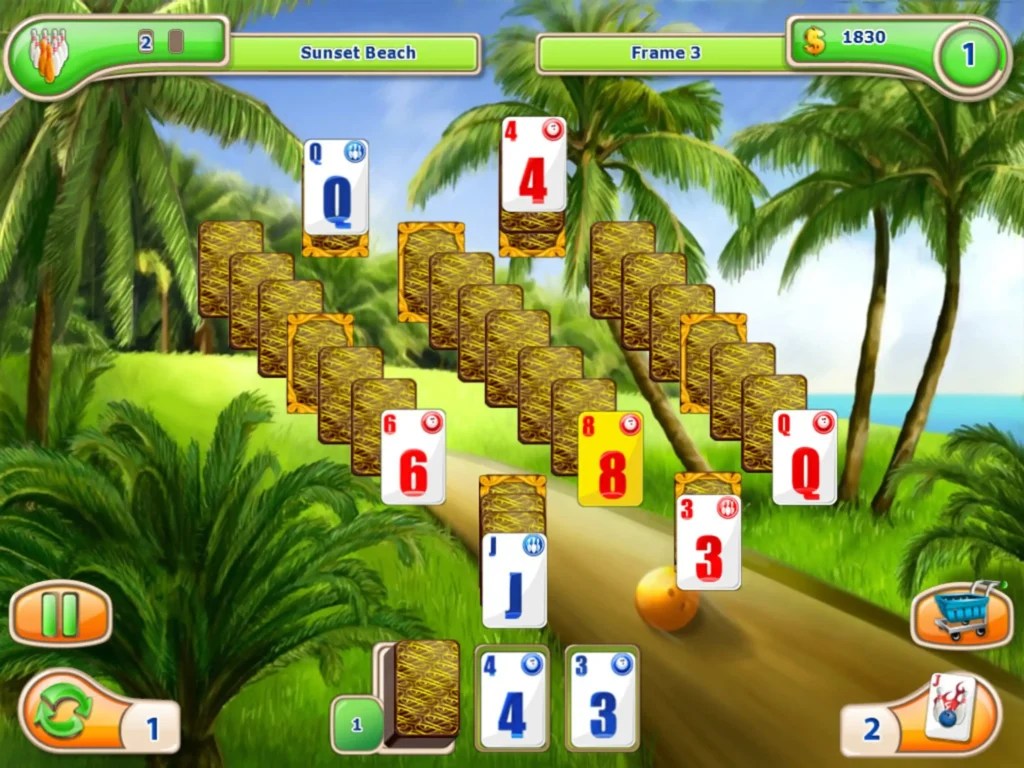
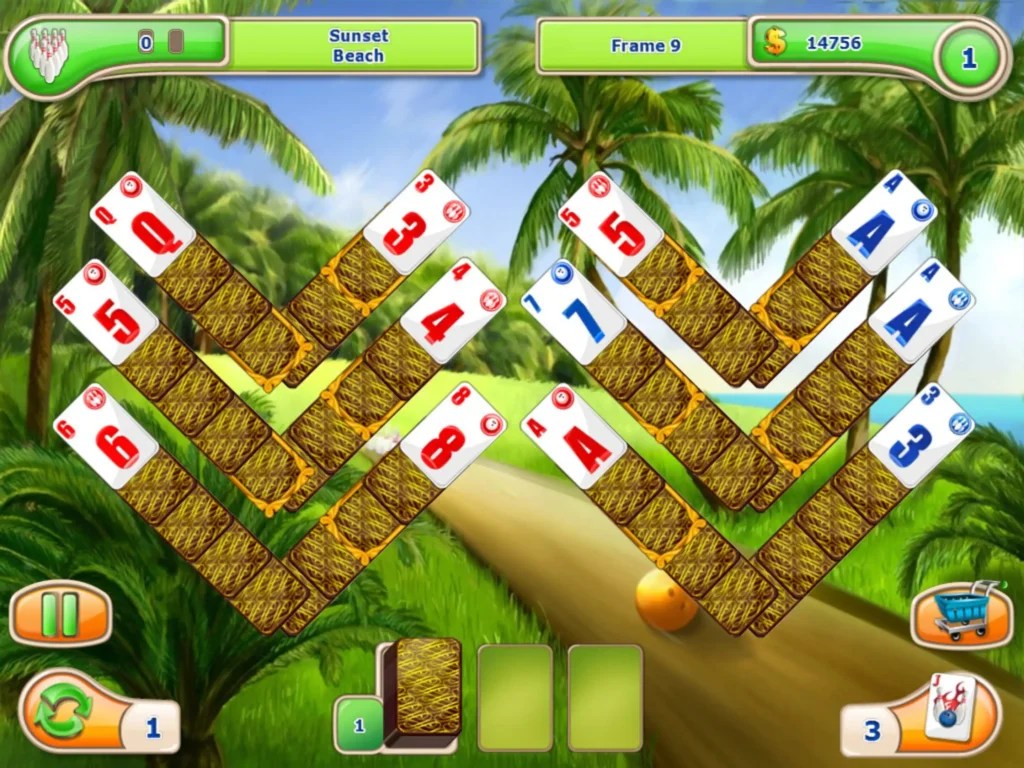
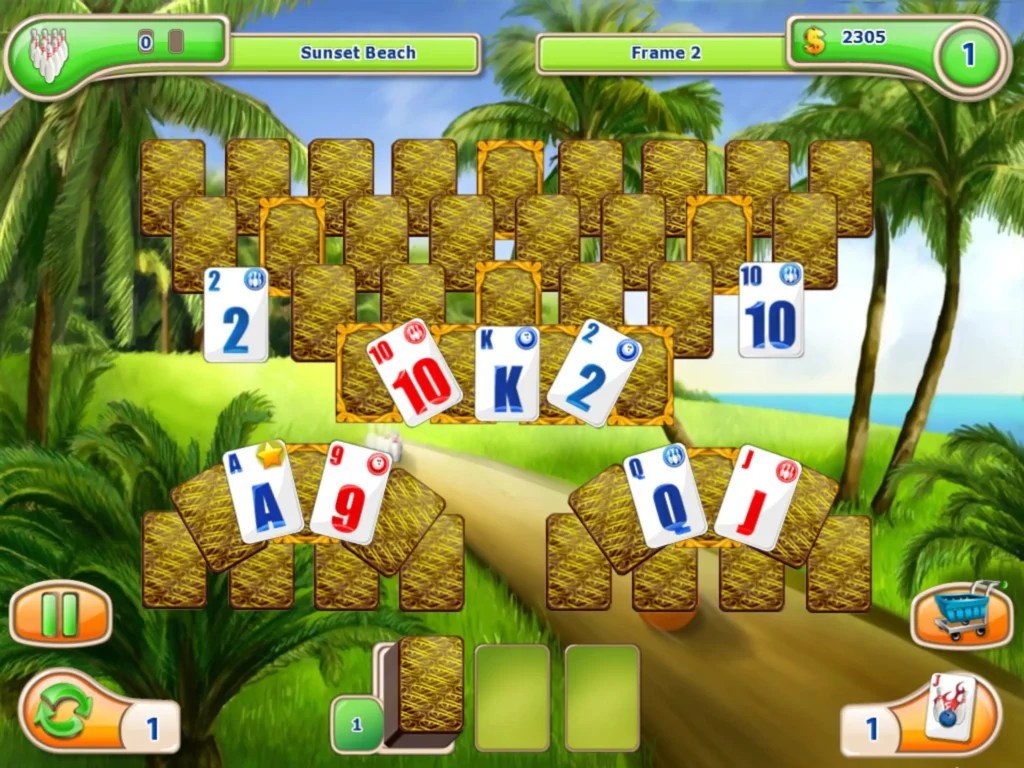
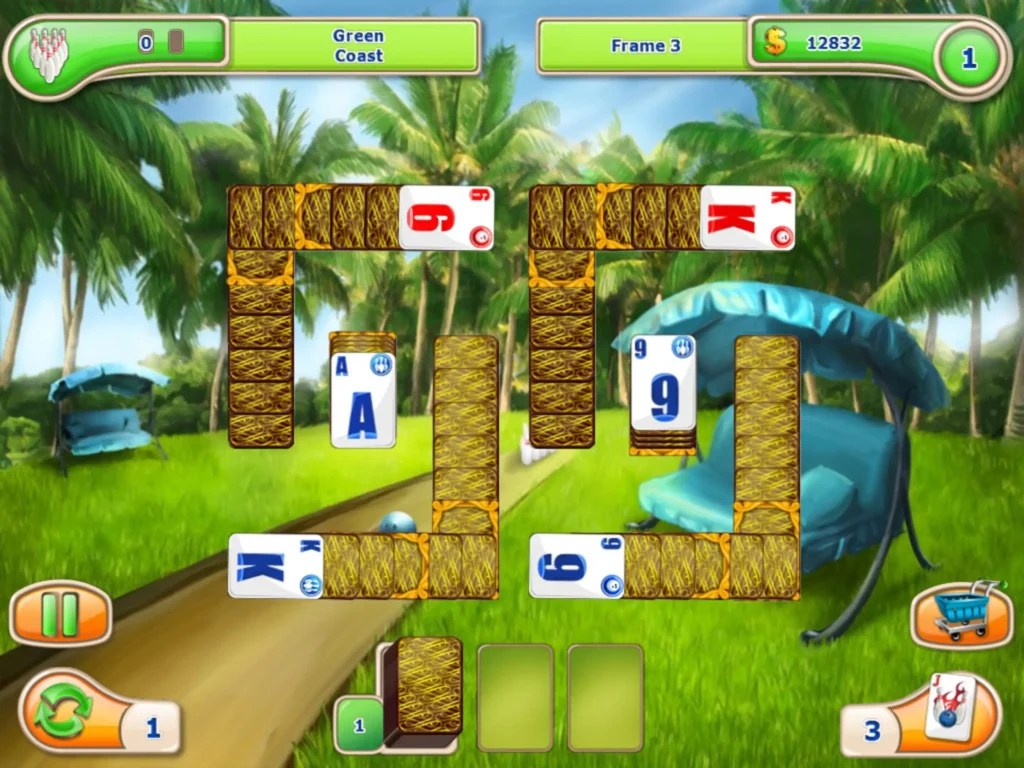
Each of the 120 levels is its own frame. The board is a 7×7 grid of face-up cards plus a couple of face-down stacks, and your starter card sits at the bottom. You click your way up, down, sideways, chaining together runs like 8-9-8-7-6-A-2-3. Every card you remove is worth pins; clear the last card and watch a bowling scorecard animate a strike. The game then tallies experience points, hands out up to three stars, and nudges you toward the next lane.
Sounds brainless? At first, yes. The opening 30 levels are a vacation in themselves; you can probably clear them while half-watching YouTube. But around frame 35 the designers start hiding key cards under multiple face-down layers, or they’ll slip in jokers that act as wilds only if you uncover them within the first 15 moves. Suddenly you’re mapping paths, counting cards, and praying the next draw flips the exact king you need to keep a 12-card combo alive.
Difficulty spikes arrive in themed batches:
- Resort World (1-30): Tutorial-plus.
- Coral Reef (31-60): Introduces “tide” cards that shuffle every five moves.
- Volcano Valley (61-90): Lava cards burn away after three turns, taking potential matches with them.
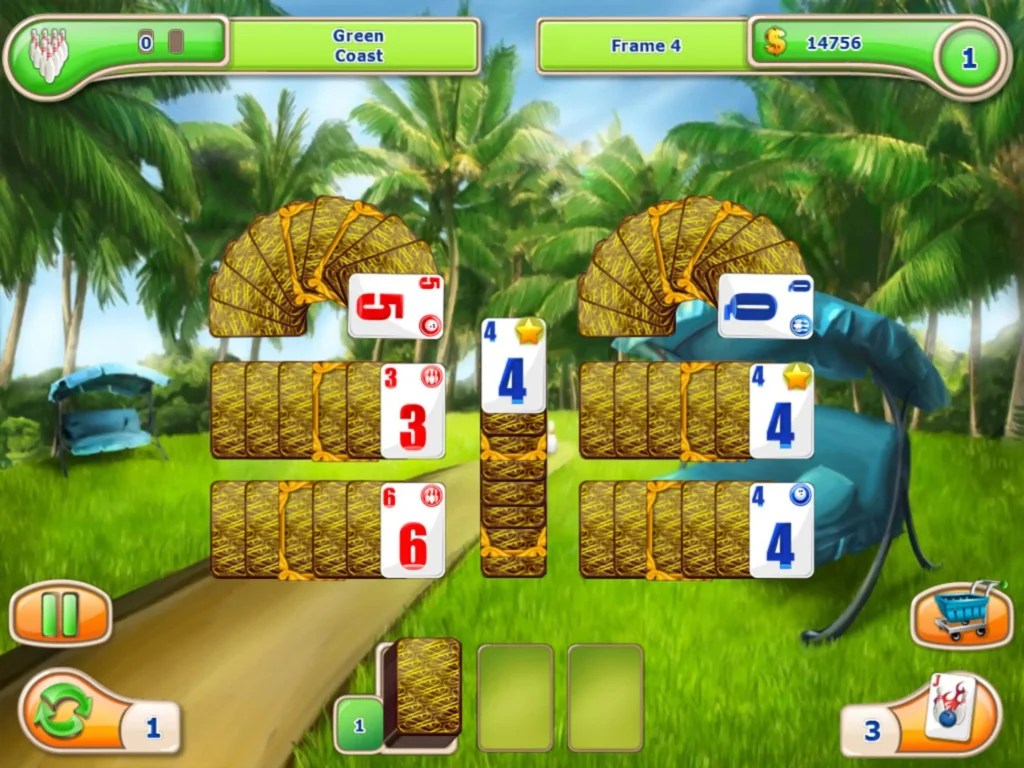
- Cloud Nine (91-120): Two-lane “splits” where you juggle two separate card fields with one deck.
Purists will argue it’s still mostly luck of the draw, and they’re not wrong. But Grey Alien Games quietly layers on just enough deterministic wrinkles—locked suits, wild cards, optional one-use power-ups—that you can tip the odds if you plan two moves ahead. Think of it as the Peggle philosophy: 70 % chance, 30 % skill, 100 % “just one more frame.”
Power-Ups & Progression: Micro-Boosts, Macro-Relaxation
Between lanes you earn shells (the soft currency) and starfish (the hard currency). Shells buy one-shot boosts: +3 cards to the deck, a wild joker planted mid-board, or the ever-satisfying “remove any single card” hammer. Starfish unlock permanent upgrades—larger hand size, higher combo multiplier, or a rewind button that lets you undo the last three moves. None of these are essential, but they smooth out the brutal later frames without making you feel like you’re straight-up buying wins.
An unexpected touch: every 20 levels the game asks if you want to bump the difficulty up or down. Casual players can drop to “Relaxed,” which removes the deck limit entirely, while masochists can opt for “Pro,” where you lose a star for every reshuffle. It’s a small courtesy that keeps the game from alienating either end of the solitaire spectrum.
Presentation: Lo-Fi Beats to Chill and Clear Cards To
Graphically, Strike Solitaire 3 isn’t gunning for any awards. The 2-D art is crisp but static: think hotel pamphlet rather than Disney ride. That said, the color palette nails the escapist fantasy—turquoise waves, pink sunsets, and the occasional humpback whale breaching in the background. Card faces are large and readable on both a 1080p monitor and a 7-inch Steam Deck screen, and the UI scales cleanly without the tiny buttons that plague so many casual ports.
Audio design is where the game over-delivers. The soundtrack bounces between mellow reggae, Hawaiian slack-key guitar, and soft EDM pads, all mixed low enough to keep repetition fatigue at bay. The bowling alley ambience—faint ball returns, distant pins, muffled crowd cheers—layers under the music rather than on top of it, creating a weirdly convincing sense of place. Headphones recommended.
Performance & Tech: Runs on a Toaster, Loads Like Lightning
Built on the same in-house engine Grey Alien used for Ancient Enemy and Regency Solitaire, Strike Solitaire 3 is staggeringly light. The full install clocks in at 312 MB. On a Ryzen 5 3600 with an RTX 3060 it loads a level in under two seconds; on an old Surface Pro 3 (dual-core i5, integrated graphics) it still maintains 60 fps with vsync on. Cloud-save support is present via Steam, and the game correctly remembers mid-level progress if you alt-tab away.
The only technical hiccup we spotted: alt-entering fullscreen occasionally nudged the cursor calibration a few pixels left, requiring a quick game restart. A patch dropped during review that shrunk the issue, but it still pops up once every couple of hours. Hardly a deal-breaker.
Replay Value: 120 Levels, but Then What?
Finishing every frame took us roughly eight hours, including snack breaks and one ill-advised attempt to marathon the final 20 levels in a single sitting. Once the credits roll you unlock “Endless Vacation” mode: a randomized lane generator that pulls card patterns from the campaign but shuffles their order and adds mutators (ice cards, bomb cards, mirror boards). Daily challenges—one board, one leaderboard, one shot at glory—arrive every 24 hours with seeded RNG so everyone competes on identical footing.
Trophy hunters will appreciate that the full 1000 Gamerscore (or 12 Steam achievements) is attainable in a single playthrough, though two are missable if you stubbornly refuse to use power-ups. There’s no new-game-plus, no branching story, no collectible cosmetics. The upside: you can 100 % the title in under ten hours and bounce out feeling satisfied rather than obligated.
Pricing & Value Proposition: A Frappuccino That Lasts All Week
At $4.99 full price, Strike Solitaire 3 costs less than most coffee-shop beverages and delivers roughly one hour of entertainment per dollar even if you only play through the campaign once. Sales already push it to $3.49, and Grey Alien has a history of 50 %-off bundles within six months of launch. There are no microtransactions post-purchase; shells and starfish are earned strictly in-game. Compared with the $9.99–$14.99 price tags on bigger casual titles (looking at you, Solitaire Chronicles), the math is easy.
The Not-So-Good: Where the Game Gutter-Balls
- Luck swings can feel brutal. Spending five minutes on a single board only to fail because the final four cards are the same suit you can’t match is deflating.
- Music variety tops out at 12 tracks. After the third hour you’ll either reach for Spotify or mute the vacation vibes entirely.
- No level editor or Steam Workshop support. The community would eat up the chance to craft sadistic lanes, but the tools aren’t there.
- Story is nonexistent beyond flavor text. A breezy narrative about touring island resorts could have glued the frame jumps together, but the devs opted for pure gameplay.
- Mobile port is MIA at launch. Grey Alien says it’s “on the roadmap,” but for now you’re tethered to PC or Mac.
Who Should Buy Strike Solitaire 3?
Buy it if you:
- Need a stress-free puzzler to play while listening to podcasts.
- Loved the earlier Strike Solitaire entries or Grey Alien’s Regency Solitaire.
- Want something that runs flawlessly on Steam Deck or a low-spec laptop for flights.
- Chase achievements that don’t require 200-hour grinds.
Skip it if you:
- Demand deep strategic layers or competitive multiplayer.
- Expect flashy 3-D graphics and cinematic set pieces.
- Already burned out on golf-solitaire hybrids and can’t stomach more of the same.
Final Verdict: 6.5 / 10 – A Cheap, Cheerful Getaway
Strike Solitaire 3 is the gaming equivalent of a three-day weekend at an all-inclusive resort you snagged on Groupon: the towels are fluffy, the drinks are watered-down but tasty, and you probably won’t remember every detail six months later—but you’ll leave relaxed and oddly content. It doesn’t revolutionize either of its parent genres, yet the mash-up is greater than the sum of its parts, and the price of entry is almost impossible to argue with.
Light some scented candles, queue up your favorite lo-fi playlist, and let the sound of distant strikes carry you away. You’ve earned a vacation—even if it’s only 312 megabytes wide.
Review Score
6.5/10
Art
Cover Art

Screenshots