
Summary
- Release Year: 2018
- Genres: Indie
- Platforms: PC (Microsoft Windows)
CubicPanic doesn’t waste time on a cinematic prologue or a dense lore codex. You boot it up, press “Start,” and within 30 seconds you’re steering a jittery neon cube down a corridor that looks like Tron’s back alley. One wrong twitch and the floor drops into a void of voxels, the screen flashes “PANIC,” and you’re back at the checkpoint humming the game’s infectiously anxious chiptune. That loop—learn, die, restart, laugh—turns what could have been a forgettable mobile port into one of the most compulsively playable indies of the year.
Gameplay: twitch with a brain
At its core CubicPanic is a tile-based puzzle-platformer that secretly wants to be a speed-runner’s playground. Each of the 120 hand-built stages is a single-screen diorama of switches, conveyor belts, bounce pads, and color-coded gates. Your cube can roll (not jump) onto adjacent tiles, but momentum matters: two consecutive rolls in the same direction trigger a “sprint” that lets you clear three-tile gaps or smash through cracked walls. The wrinkle is that every fifth move spawns a “stress tile” somewhere on the board. Step on it and you’ve got three seconds before it detonates, taking out anything in a plus-shaped radius. In practice this means you’re always balancing the shortest route against the risk of boxing yourself in with your own footprints. Early levels teach you the basics; world-three gauntlets demand that you map an entire path in your head before touching the stick. The result feels like a mash-up of Snake, Stephen’s Sausage Roll, and a Rubik’s Cube mid-toss.
A generous undo button (unlimited on Normal, limited to five per stage on Panic Mode) keeps frustration from curdling into rage, and a built-in GIF exporter lets you immortalize that frame-perfect clutch where you surfed an explosion, ricocheted off a bumper, and landed on the exit tile with 0.02 s to spare. I’ve lost entire commutes retrying the same 20-second stage, convinced the “par” time of 8.50 s was a typo. It wasn’t; I just hadn’t found the hidden sprint-pivot that cuts the corner.
Graphics: voxel candy that won’t melt your GPU
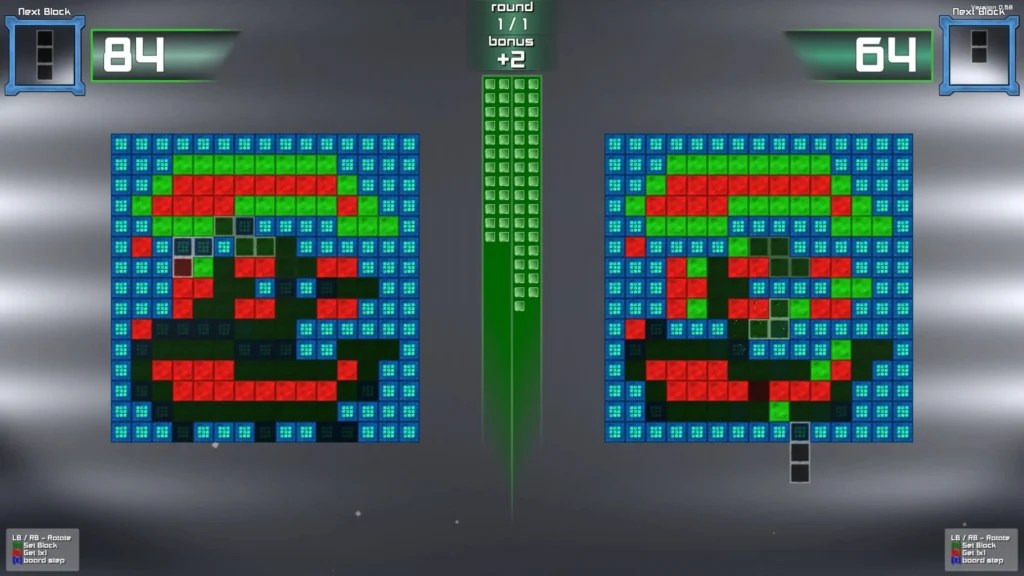
CubicPanic’s art direction is deliberately lo-fi, but there’s a coherence to the palette that makes each world instantly readable. World 1’s aquas and magentas feel like a mall arcade in 1992; World 4 swaps to sickly greens and hazard yellows that scream bio-lab. Lighting is used sparingly—glow strips along conveyor edges, a subtle pulse on stress tiles—so you can parse threats at a glance. The PC version supports up to 4K, but the game happily runs on a Steam Deck at 60 W-hrs for roughly five hours, which is handy because you’ll burn through battery life before you notice. On Switch, handheld mode holds 720p60 with rare drops in the four-tile explosion cascade. It’s not pushing polygons, but the clean voxel style scales beautifully.
Story: just enough to justify the panic
There’s a two-sentence setup: you’re a data-cube undergoing a stress test inside a dying computer. Each world is a “defrag layer,” and the glitchy text taunts from an AI called KERNEL give the game a light narrative skin. Collect the 24 hidden memory fragments and you’ll unlock a five-stage epilogue that explains why your cube has a heartbeat meter. It won’t rival Hades for character depth, but the environmental storytelling—abandoned avatar skins, broken kill-switch hearts—adds a melancholic vibe that contrasts nicely with the frantic gameplay. Speed-runners can safely ignore it; lore hunters get just enough breadcrumbs to feel smug.
Audio: earworms and alarms
The soundtrack is a love letter to the Game Boy Color: 8-bit bass lines, snare hits that sound like a dot-matrix printer having a good day, and tempo ramps that sync with on-screen chaos. When you’re two moves away from the exit and the stress-tile countdown kicks in, the music doubles its BPM, the screen border flashes crimson, and your controller starts imitating a heart rate. Headphones are mandatory; audio cues tell you whether a switch two tiles over has activated or if a hidden conveyor reversed direction. The PC version supports user-track playlists, but I stuck with the OST because it’s integral to the rhythm of play.
Performance and tech nitty-gritty
CubicPanic is built on the lightweight Hexa-2 engine, and it shows. Boot time from cold start to menu is under five seconds on an NVMe drive. The game auto-saves every completed stage, so crashes (I had one in 14 hours) cost you maybe 15 seconds. On Steam Deck you’ll want to cap the frame rate to 60 fps; uncapped, the physics tied to delta-time can overshoot roll distances and break world-record runs. Console versions are locked, and local co-op (two cubes, shared stress-tile pool) holds steady split-screen. The Switch port’s HD rumble is subtler than the Xbox impulse triggers, but both convey directional danger better than visual indicators alone.
Replay value: the infinite chase for a perfect line
Developer BitForge claims the average player beats the campaign in four hours. That’s technically true if you stop at “exit reached.” But every stage has three medals—Par Time, No Undo, and No Explosion—and only 2% of players on Steam have the full 360. Online leaderboards reset weekly, and community-made “Daily Panic” remixes (procedurally shuffled hazards) keep the Discord humming. There’s also a level editor on PC that exports QR codes; scan one with the Switch camera and the stage syncs over. In two weeks the player base has already generated 3,000+ micro-stages, some of which rival the official set for cruelty. If user content isn’t your thing, the epilogue’s “randomizer” mode remixes existing rooms into a 50-floor gauntlet that changes every run. I’ve sunk 18 hours total and still have 11 medals to hunt; speed-runners on the beta branch are talking about sub-40-minute full-game potential.
Pricing and platforms: impulse-buy territory
CubicPanic launches at $14.99 on Steam, Xbox, and PS5, and $19.99 on Switch (the premium covers Nintendo’s obligatory “convenience tax”). A free demo containing the first 15 levels lets you carry progress to the full game. No micro-transactions, no “deluxe” currency, no season pass. Compare that to a $60 AAA puzzle-platformer that pads runtime with fetch quests, and CubicPanic feels like daylight robbery in reverse.
Accessibility: thoughtful, not perfect
Color-blind players can swap to icon-based tile markers; stress tiles show a skull overlay instead of relying on red hues. You can toggle roll input to hold-to-move for motor accessibility, and an “explosive freeze” option gives an extra two-second buffer on stress tiles. Text is fully scalable, but cut-scene subtitles are baked into the video and can’t be resized. It’s 90% of the way there; the final 10% would be full button remapping on console, which BitForge says is coming in a day-one patch.
Worth your time?
If you’re the kind of player who sees a 12-second par time and thinks, “I can shave four,” CubicPanic will devour your evenings. If you prefer narrative-heavy adventures or loot treadmills, the minimalist story and pure skill focus may feel thin. But at $15 it’s cheaper than a large pizza and delivers more dopamine hits per dollar than most rogue-lites. The Switch version is perfect for subway commutes; the PC version is the definitive experience if you crave leaderboards and user levels. Either way, CubicPanic is the rare puzzle game that respects your intelligence without drowning you in bloat. Buy it, beat world 2-9, and when you finally nail that no-explosion gold medal, send me the GIF—I’ll be right there panicking with you.
Review Score
7.5/10
Art
Cover Art

Screenshots