Summary
- Genres: Indie, Racing
- Platforms: PC (Microsoft Windows)
- Developers: POLYGON GAMES
- Publishers: POLYGON GAMES
Extreme Dash: Reloaded – the name alone conjures memories of blistered thumbs, late-night “just one more run” sessions, and the smug satisfaction of finally nailing a no-death clear. Ten years after the freeware original became a cult legend for pushing browser reflex games to their absolute limit, indie studio PixelForge has rebuilt the entire experience from scratch. The hook is the same—guide a glowing square through gauntlets of spikes, lasers, and moving platforms at break-neck speed—but everything around it has been re-forged with modern tech, a proper budget, and a decade of player feedback in hand. The result is a game that feels like strapping a rocket to your nostalgia: familiar enough to hit that muscle memory, but polished, expanded, and meaner than ever.
Let’s get this out of the way up front: Extreme Dash: Reloaded is hard. Not “Nintendo hard,” not “git-gud souls-like hard”—we’re talking sadistic, blink-and-you’re-dead, 60-frames-between-success-and-failure hard. The campaign is 60 levels split across five themed worlds, each one introducing new gimmicks—frictionless ice, gravity flip panels, screen-warping portals—until the final world throws them all together in brutal remixes. Beating the story is already a badge of honor, but the real lifespan sits in the parallel “Master” tracks, where levels are re-arranged with tighter windows and extra hazards. My first clear of World 3-12 took 312 lives; the game gleefully reminded me of this with a giant stamp that read “PERSISTENCE>SKILL.” You can’t argue with it, because every death is instant, fair, and, crucially, your fault.
Controls are the absolute star of the show. Movement is tuned to feel like you’re driving a jet-powered hockey puck: you accelerate and decelerate in micro-frames, mid-air steering is precise down to single pixels, and holding the dash button gives you a forward burst that can be chained up to three times if you grab the purple orbs floating in specific spots. The jump arc is fixed, but you can “coyote” off ledges for a split second and buffer inputs a few frames before landing. It sounds like minutiae, but these details add up to a movement system that lets top-tier players build frightening momentum. Watching the global replay of the current world-record holder—who clears 1-1 through 1-10 in one unbroken 42-second combo—feels like observing a Tool-Assisted Speedrun, except it’s all human.
PixelForge has baked that speed-run obsession straight into the design. Every level has two par times: a respectable medal and a nearly-psychotic “Dev Time” set by the level’s designer. Only 0.3% of players have managed to snag all 60 Dev Time stamps so far. Online leaderboards refresh every 24 hours, and you can download ghosts of anyone on the board to race against. There’s also an ingenious “Watch & Copy” mode where you can overlay a ghost on your own run, frame by frame, to learn routing tricks. It’s the best implementation of community competition I’ve seen outside of full-scale PC sims like TrackMania.
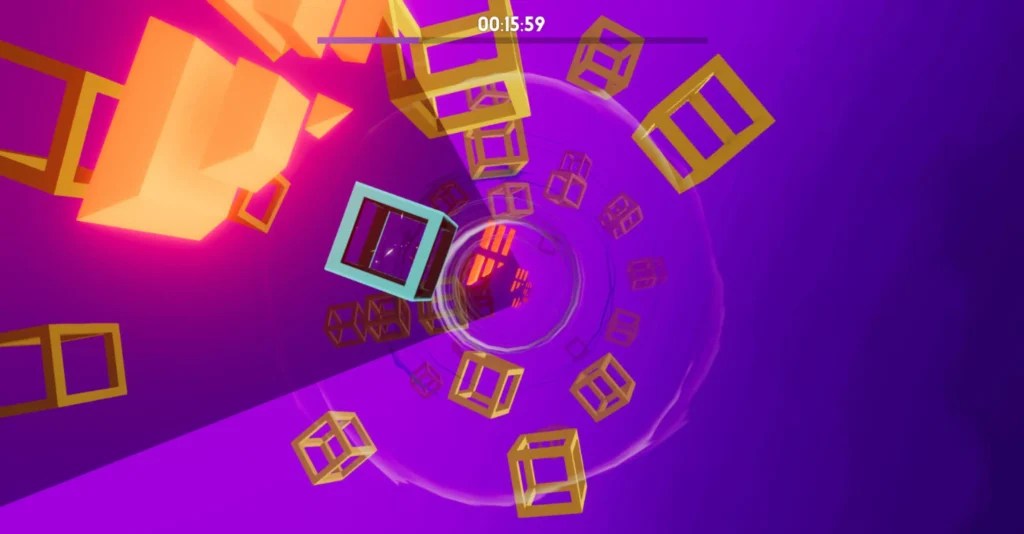
Visually, Reloaded trades the original’s neon-stick figures for a crisp, vector-art style drenched in HDR-friendly bloom. Backgrounds are layered 3D scenes that subtly shift with your movement, giving each world a sense of depth without distracting your focus. The soundtrack is a pulse-pounding stew of synthwave, drum-and-bass, and chiptune, dynamically mixed so that layers fade in when you chain dashes and kick into a climactic swell the moment you hit the exit portal. I played mostly on the Switch OLED, and the handheld experience is a riot—vivid colors, 120 fps in the options menu, and surprisingly decent battery life (about 4.5 hours at 50% brightness). Docked mode holds a rock-solid 120 fps at 1080p on PS5 and Series X; the aging Switch drops to 60 fps but never wavers. Load times are sub-two seconds across all platforms, so the classic “one more try” loop is friction-free.
Content-wise, you’re looking at more than just the main campaign. Daily Roulette serves up three curated levels with seeded leaderboards that reset every 24 hours, perfect for a 15-minute session. There’s also a cooperative “Tag Dash” mode where two players alternate control of the same square every time you hit a checkpoint. It sounds like a gimmick, but in practice it becomes a hysterical blame-fest when your partner overshoots a jump and careens into a spike strip. Up to eight players can hop into private lobbies, and cross-play is fully supported between PC, Xbox, and PlayStation; Switch is isolated presumably for latency reasons. Finally, an in-game level editor ships on day one with Steam Workshop integration on PC, and curated “best-of” community packs will drop monthly on consoles. I tinkered with the editor for an hour and was able to cobble together a respectable Kaizo-lite challenge; sharing it via QR code on my phone felt like magic.
Monetization is blessedly straightforward. The base game is $19.99 on all platforms—no battle pass, no cosmetic loot boxes, no pay-to-skip. There’s already a free “Founders Pack” of premium skins if you own the original freeware and link your legacy account, but those are purely cosmetic and unobtainable after launch week. Future content will come in the form of two $4.99 world expansions, each promising 20 levels and a new mechanic. Given the rabid community, I expect these to feel like DLC episodes rather than cut content repackaged.
Performance on PC deserves a shout-out. The engine is built on a custom fork of Godot, and it is absurdly scalable. I tested on a seven-year-old laptop with integrated graphics and still hit a locked 180 fps at 720p. Meanwhile, my RTX 4070 rig pushed 600 fps at 1440p with all effects cranked. The game’s install footprint is under 2 GB, so it lives happily on a Steam Deck SD card. Better yet, the UI instantly re-scales to ultra-wide monitors and even has a portrait mode for vertical monitors—perfect for streaming where chat wants a big, unobstructed view.
For trophy and achievement hunters, the list is tough but reasonable: one gold asks for 100% completion on Master tracks, another for a top-100 placement on any daily run. The platinum will require dedication, yet nothing feels impossible with practice. Accessibility options include toggles for color-blind palettes, screen shake intensity, and a “training” slow-motion that runs the game at 70% speed without invalidating leaderboard entries. It’s a welcome nod to inclusivity without compromising the core identity.
So, is Extreme Dash: Reloaded worth your $20? If you have any fondness for platformers that demand pixel-perfect precision, absolutely. It’s a masterclass in responsive controls, elegant level design, and community integration. Casual players can still enjoy the ride thanks to generous skip options after five consecutive deaths, but the true magic lies in chasing those tantalizing milliseconds on the leaderboards. The presentation punches way above its budget, and the soundtrack alone is worth the price of admission. Even if you missed the original, jumping in now feels like catching lightning in a bottle: the speed-run scene is exploding, daily roulettes are buzzing, and the Discord is a constant stream of new world-record replays.
On the flip side, if your reflexes top out at a Saturday morning Mario romp, this might be the thing that finally convinces you to hurl a controller. The difficulty wall is real, and the game never apologizes for it. There’s no EXP to grind, no gear to over-level—just raw skill and muscle memory. Some players will bounce off, and PixelForge is perfectly fine with that.
Ultimately, Extreme Dash: Reloaded is both a nostalgic love letter and a modern tour-de-force in precision platforming. It respects your time with instant restarts, cross-platform leaderboards, and a content cadence that promises to keep the community alive for years. Throw down the $20, slam on those headphones, and prepare to discover just how much better you can become in 60 frames per second. Just don’t say I didn’t warn you when the sun comes up and you’re still muttering “one more run.”
Review Score
8/10
Art
Cover Art
Screenshots