Summary
- Release Year: 2018
- Genres: Adventure, Indie, Role-playing game (RPG)
- Platforms: Linux, Mac, PC (Microsoft Windows)
- Developers: Choice of Games
- Publishers: Choice of Games
Silverworld
Choice of Games | PC, Mac, iOS, Android | $5.99 (no micro-transactions) | 580,000-word interactive novel | Single-player | No voice acting, no 3-D models—just your imagination and a finger on the screen.
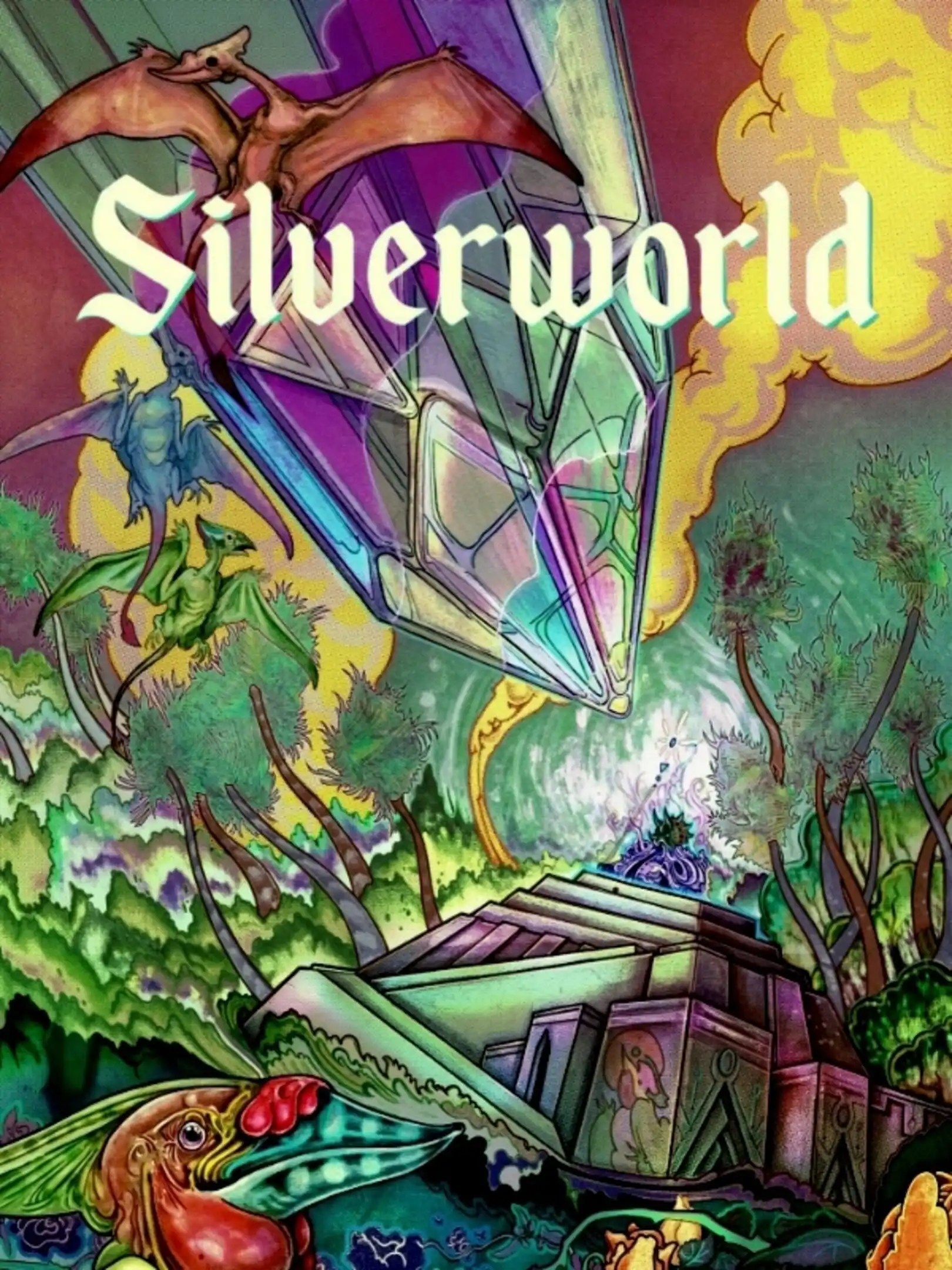
The elevator pitch is pure pulp daydream: your archaeological expedition is flung a thousand years into the past and dumped in a rain-forest basin ruled by rival city-states, colossal crystal-skulled beasts, and a silver-plated meteorite that might be sentient. Survive, side with, or subjugate the locals, then decide whether to haul priceless artifacts back to the future or stay and forge a new civilization. Think “Lost City of Z” meets “Chrono Trigger,” but told entirely through text and branching choices.
If your first reaction is “Wait, no graphics at all?” you’re not alone. Yet Silverworld proves—sometimes violently—that the most powerful GPU is still the human brain. In 580,000 words (longer than The Lord of the Rings trilogy) every paragraph is a Lego brick you snap together into a story no one else will replicate. After five full play-throughs my timelines looked like five different genres: political thriller, survival horror, cozy settlement sim, doomed romance, and cosmic horror heist. That multiplicity is the game’s killer feature and, paradoxically, its biggest ask: you have to read—avidly, constantly, critically—to earn your fun.
Story & Role-Playing: 9/10
Writer Kyle Marquis (Champion of the Gods, Empyrean) specializes in big-canvas power fantasies that still track emotional minutiae. Silverworld is his most grounded work to date, trading godhood for grit. You can still end life as a deified jaguar spirit, but you’ll remember the first time you tasted roasted manioc or stitched a wound with jungle creeper. The opening chapters establish a razor-thin equilibrium: your modern knowledge is priceless, your modern body is fragile. One bad roll can leave you with a shattered femur and a gangrenous future. The game weaponizes inventory management—antibiotics, AA batteries, the last Clif bar—but never lets it devolve into spreadsheet busywork. Every resource is a story beat: gift chocolate to a child queen and you’ll seed a religion around cacao.
Branching is ferociously reactive. There are four primary factions—techno-pacifist scholars, iron-fisted expansionists, jaguar cult theocrats, and the enigmatic Silverworlders who worship the meteor—but you can crown yourself a fifth, sixth, or seventh power by mixing ideologies. I accidentally invented a constitutional monarchy after convincing a war-chief that term limits made him more legendary than dying in battle. The game shrugged, updated every variable, and let me rule for 40 in-story years. Even minor choices loop back: teach a farmer crop rotation and you’ll return decades later to find his grandson running an agricultural empire that funds your war chest.
Romance options are gender-flippable and orientation-open, but more impressive is how relationships mature. My first partner, the sarcastic linguist Dr. Blanco, evolved from comic relief to political rival after I sacrificed his research to save refugees. We broke up via stone tablet. In another timeline I married the jaguar priestess Itzel; our polyamorous triad adopted a foundling who later became a diplomat, giving me a diplomatic ending I didn’t know existed. The game never flashes a “+1 Relationship” pop-up; instead, characters quote your shared history back at you, a quiet flex of the underlying code.
World-Building: 8.5/10
Silverworld’s Mesoamerican basin feels like a place that could have existed. Marquis layers real archaeological touchstones—raised-field agriculture, obsidian macuahuitl, bark-paper codices—with speculative flourishes: ley-line-powered ballgames, a sentient metal that colonizes hosts like a fungal hive. The result sidesteps both colonial tropes and “noble savage” clichés. Indigenous characters are engineers, philosophers, comedians, jerks—full humans, in other words. The future timeline you left behind is equally fleshed; news clippings, academic emails, and a hilariously woke museum board meeting drip through flashbacks, reminding you that 2024 has its own cults and conquistadors.
Gameplay Systems: 8/10
Stats are classic Choice-of-Games: six core (Observation, Combat, Diplomacy, Tech, Survival, Culture) plus hidden meters (Renown, Terror, Time Paradox Risk). The genius twist is “Temporal Stability.” Every future-tech convenience you introduce—steel, penicillin, guns—frays the timeline. Let the meter max and you’ll summon “The Fracture,” a reality-eating storm that gobbles save files. I lost a 12-hour colony sim run to a hurricane of broken clocks and floating numerals. Frustrating? Absolutely. But the game telegraphed every warning; I’d just ignored them. Roguelike players will call it fair; save-scummers will howl.
Combat is resolved via choices, not dice. A typical encounter offers 3–5 approaches, each locked behind stat thresholds. Fail and you usually take a “scar”—a permanent narrative wound that can open new solutions. My favorite scar, “Obsidian Eye,” replaced my left eye with a volcanic-glass prosthesis that glows near silver deposits, letting me detect ambushes but also attracting every would-be thief. The loop encourages experimentation rather than optimization.
Economy deserves special praise. You can haul jade, quetzal feathers, or even a steam engine back to the future, but prices crash if you flood the market. I smuggled one single obsidian mirror and funded my dig site for a decade; a friend dumped twenty and tanked global obsidian futures, locking him into a poverty ending. It’s the rare game where supply-and-demand feels like storytelling, not math homework.
Graphics & Presentation: N/A (and that’s the point)
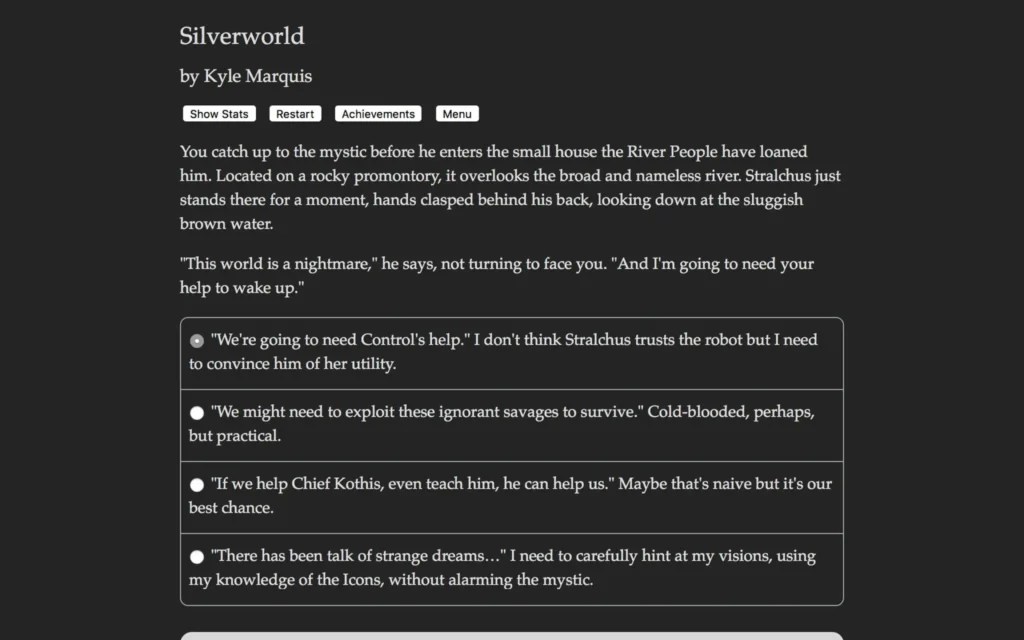
Silverworld is a 1.3 MB download that runs on a potato. Fonts are customizable; dyslexia-friendly mode is one tap away. Backgrounds shift color subtly—emerald for jungle scenes, lunar silver for meteor temples—evoking mood without distracting. Sound is limited to page-turn swooshes you can disable. If you need ray-traced jungles, bounce. If you ever lost a weekend to a fat fantasy paperback, this is your comfort food.
Performance & Accessibility: 9/10
The game auto-saves every choice; cloud-sync between PC and phone is flawless. I hot-swapped from iPhone on the subway to Steam Deck at home and resumed mid-sentence. Screen-reader support is baked in; every stat check is announced before you click, so visually-impaired players can weigh odds. The only hiccup I hit was on a Galaxy S23 where the keyboard occasionally overlapped text; rotating to landscape fixed it.
Length & Replay Value: 10/10
A “speed read” sprint is 6–7 hours; completionists will chew 30+. There are 22 major endings and, more importantly, thousands of micro-epilogues for side characters. The achievements list (Google Play/Steam) is 60-strong and deliberately contradictory—you can’t become both “Pacifist” and “Conqueror” in one run. I’ve sunk 42 hours across six timelines and still discover new scenes: a hidden cenote city, a time-loop romance, a post-credits stinger that hints at a shared universe with Marquis’ earlier title “Tower Behind the Moon.”
Pricing & Ethics: 9/10
Six bucks buys the entire game—no DLC, no coin doubler, no energy timer. That’s cheaper than a Marvel movie combo and you get roughly five novels of prose. The only monetization is a “Tip the Developer” button that appears after the credits. I kicked in another $5 because the experience is worth more than the asking price. No loot boxes, no FOMO battle pass, and the privacy policy is a single sane paragraph: no data sold, analytics anonymized.
What’s Not Great
- Learning curve: the first hour bombards you with proper nouns. A built-in codex unlocks gradually; until then, you’ll swear you’re cramming for a Mesoamerican civ mid-term.
- Stat walls: a few late-game checks demand 70+ in a single skill; hybrid builds can hit brick walls with no graceful bypass.
- Horror content: body horror and child death can be toggled, but the toggles are buried three menus deep.
- No voice acting: for some, walls of text are a non-starter.
- Ending whiplash: because epilogues are modular, you can get a triumphant paragraph followed by a downer stinger. Feels like Netflix canceling your favorite show mid-sentence.
Comparisons
If you loved 80 Days, Sorcery!, or Citizen Sleeper, Silverworld scratches the same “interactive literature” itch but with grander scale and heavier strategy. It’s less intimate than Pendragon, more systemic than most visual novels, and far more hopeful than The Banner Saga’s nihilistic trudge.
Verdict: 8.2/10
Silverworld won’t sell you on photorealistic ferns or orchestral boss themes. Instead, it sells you on the giddy rush of watching a civilization pivot because you taught them the plow, or the heartbreak of a partner who remembers every promise you broke. It’s a $6 ticket to a jungle where your choices echo across centuries, and where the only limit is how much story you’re willing to read. Bring a machete for the vines, but bring an imagination for everything else.
Review Score
8/10
Art
Cover Art

Screenshots