Summary
- Release Year: 2018
- Genres: Indie
- Platforms: PC (Microsoft Windows)
Deadfall Tropics – the name sounds like a cocktail you’d order at a beach bar, but one sip and you realize someone slipped in a double shot of adrenaline and a dash of cyanide. Developer Moonshot Cartel hasn’t tried to reinvent the 2D-action-platformer here; they’ve distilled it—stripped out the bloat, cranked the pulp to eleven, and let you play as a luckless smuggler who parkours like a panther and complains like Nathan Drake with a hangover. After 25 hours, two speed-run attempts, and one profanity-laced showdown with the final boss, I’m ready to tell you whether this tropical gauntlet is a vacation worth taking.
Story: B-movie gold, told with a wink
You are Hank Hudson, a cargo pilot who would happily sell his grandmother for a crate of contraband. One lightning storm and a flaming engine later, Hank’s prized shipment—an ancient relic that “definitely isn’t cursed”—is scattered across a remote archipelago. The island, of course, is alive. Not in a cute “talking animal” way, but in a “stone statues fire laser eyes” way. Your only ticket out is to reassemble the relic, outrun a private-army goon squad, and somehow not get eaten by a 30-foot anaconda.
Deadfall Tropics is fully voice-acted (a miracle at this price), and Hank’s quips land more often than they miss. The writing loves its clichés—monologuing villain, mysterious female mercenary, lost civilization—but it’s aware of them. One collectible is literally “Cursed Artifact #4 of 12, Please Stop Grabbing These.” If you adored the self-aware banter of Rogue Legacy or the Saturday-matinee swagger of Uncharted, you’ll feel right at home.
Gameplay: parkour, parry, profit
At its core this is a precision platformer with a combat garnish. Think Celeste’s air-control meets Guacamelee’s punchy fisticuffs. Hank can wall-jump, air-dash, rope-swing, and—once you unlock the gliding poncho—soar across gaps that previously seemed sadistic. Levels are stitched together with Metroidvania-lite gates: you’ll spot a tantalizing relic behind breakable coral long before you earn the shoulder-charge that shatters it.
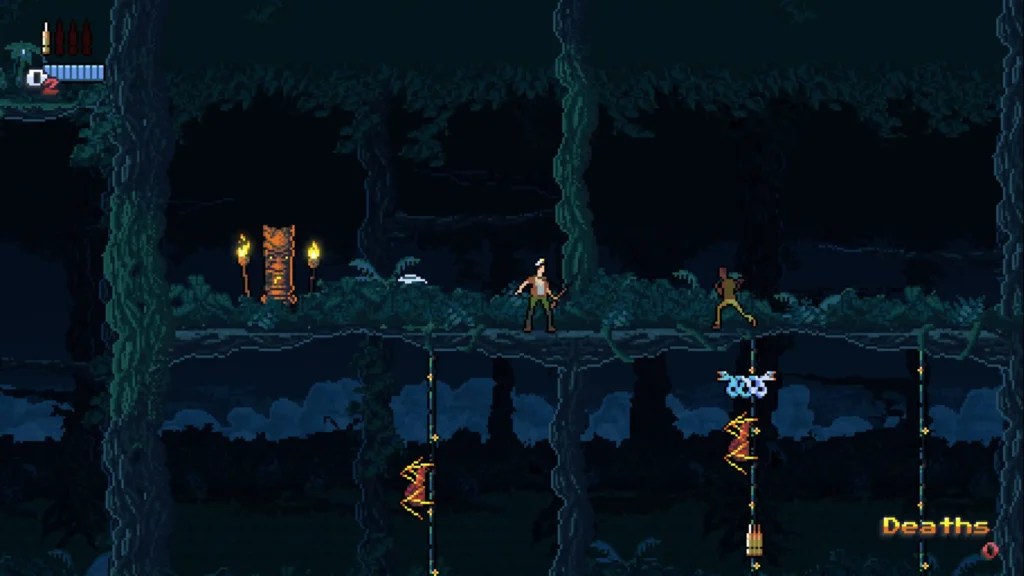
Combat is two-button elegant: one to strike, one to parry. Nail the parry window (about 12 frames) and you’re rewarded with a slow-mo flourish and a coin burst that would make a Mario coin-farm blush. Miss it and enemies delete 25% of your life bar on Hard. Bosses demand pattern recognition, but every telegraph is color-coded and fair. My only gripe is the late-game “parry-check” mobs—heavily armored brutes that can’t be damaged any other way. They’re designed to teach mastery, yet they stall momentum for players who prefer pure platforming.
Difficulty modes deserve applause. “Castaway” gives you infinite lives and checkpoints every other screen; “Smuggler” is the intended experience; and “Tropic Thunder” is essentially a no-hit run with randomized enemy placements. You can flip between them at any totem statue, so a frustrated newcomer can drop down, grab the next mobility upgrade, then jump back up for bragging rights.
Progression: loot that actually matters
Instead of incremental stat bumps, every treasure funds new traversal toys. That’s a design masterstroke: the double-jump isn’t just a double-jump; it’s a license to explore earlier zones for secret relic shards that unlock the true ending. By the time I earned the “hookshot made from an old anchor,” the world felt like a gigantic jungle gym, and I was the kid who’d outgrown the safety swing. There’s also a clever risk-reward economy: you can bank coins at mailboxes (a nod to Resident Evil’s typewriters) or gamble them for randomized relic crates. Crates can contain anything from a sassy alt skin to a game-changing “vampire” charm that heals on parry. Because crates are capped at three per biome, the loot loop never devolves into grindy.
Level design: a pixelated postcard
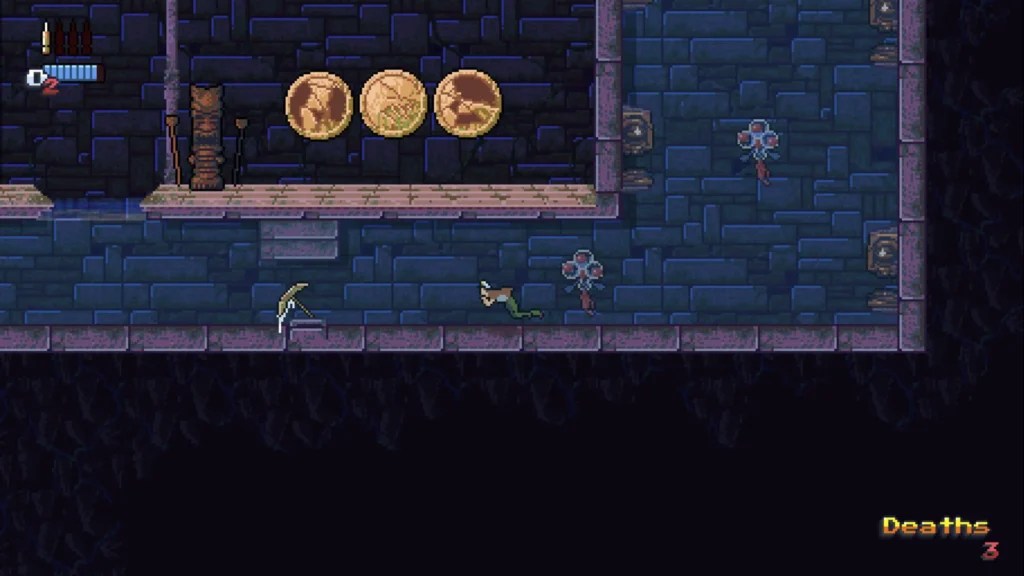
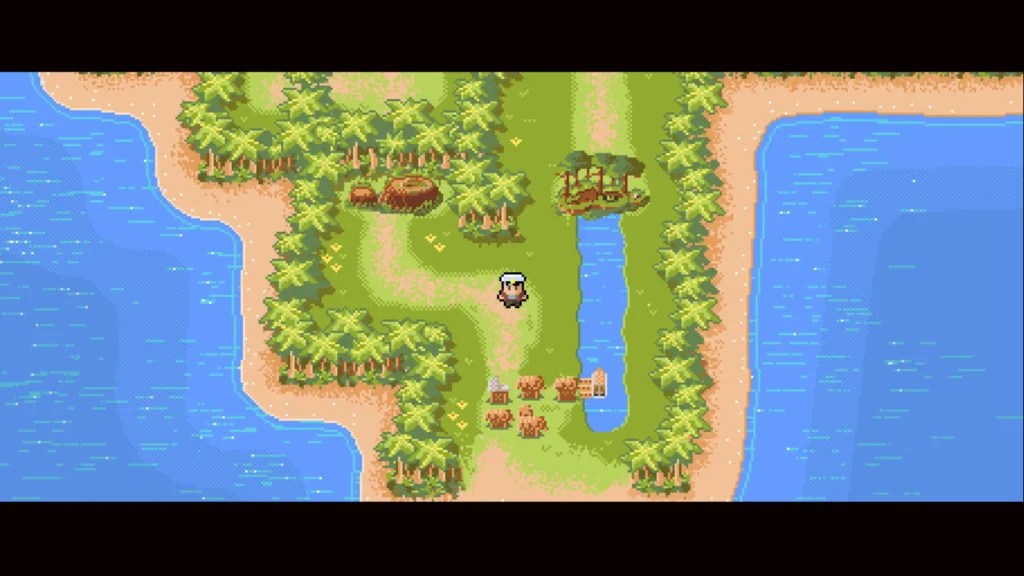
Moonshot Cartel claims every backdrop is hand-painted, and I believe it. Each of the six biomes has a distinct palette: the Turquoise Mangroves glow like a Caribbean screensaver; the Ashen Peaks are rendered in crimson ember tones that make you check your Switch’s brightness settings. Foreground geometry is readable at 60 fps, even when the screen fills with bats, lava geysers, and your own panicked flailing. Hidden tunnels reward obsessive wall-slapping; I found an entire optional cavern by back-flipping off what I assumed was scenery. Environmental storytelling is subtle but effective—plane wreckage slowly upgrades into a shanty town as Hank rescues crewmates, giving the hub world a sense of forward momentum.
Soundtrack: the summer bop you didn’t know you needed
Composer Calica Mora fuses steel drums with glitchy synths, producing a soundtrack that’s half resort luau, half cyberpunk fever dream. Tracks dynamically layer as you combo enemies, culminating in a bass drop the exact moment you unleash a perfect parry chain. Wear headphones; thank me later.
Performance: smooth sailing, mostly
On a Ryzen 5 / RTX 3060 rig the game locked at 120 fps with occasional dips to 90 when the screen exploded with particle spam. On Switch (the lead platform) it holds 1080p/60 fps docked and 720p/60 fps handheld, with one notable stutter when autosaving mid-boss. A day-one patch has already trimmed load times from 15 seconds to 4. No crashes, no softlocks, no T-posing jaguars—already a better track record than some AAA launches this year.
Length & replay value: short enough to binge, deep enough to savor
My first clear clocked in at 9 hours 42 minutes with 68% items. A 100% completionist run will push past 15 hours, especially if you chase the secret “Golden Panther” skin that requires a zero-death stretch from start to credits. Randomizer mode (unlocked after credits) remixes item placement and is going to be speed-running catnip. The game ships with an in-built split timer and seeds, so expect to see it at AGDQ.
Co-op & extras: bring a friend, or a rival
Drop-in local co-op lets Player 2 control Hank’s long-suffering mechanic, Maya. She shares his move set but gets a drone that can tag enemies for bonus coin drops. It’s not revolutionary, yet it transforms parry timing into a cooperative rhythm game. Online leaderboards track fastest clear per category, and ghosts can be downloaded so you can race against world-record pace while you play. It’s the kind of “one more run” flourish that kept me up until 3 a.m. on a work night.
Microtransactions & DLC: none, nada, zip
There is a single in-game store, but everything is bought with coins you earn by playing. No premium currency, no season pass, no $5 alternate color nonsense. The devs pinky-sore free story DLC next year, and console versions include cross-save via a simple QR code—small touches that feel positively philanthropic in 2024.
Accessibility: room to grow
Options include remappable controls, color-blind enemy outlines, and a “no fail” assist mode that auto-parries for you. There’s no full-blown invincibility toggle, so very young or motor-limited players might still hit a wall. Subtitles are on by default but can’t be resized, a minor oversight that will hopefully be patched.
Price & platforms: indie math that adds up
$19.99 on PC (Steam, Epic, GOG), $24.99 on consoles to account for platform holder cut. For a polished, content-rich adventure that respects your time and wallet, that’s daylight robbery in reverse. Game Pass and PS+ announcements are heavily rumored for the fall, but even at full price you’re looking at roughly two bucks per hour of high-grade entertainment—cheaper than a movie rental, and you get to keep the relic.
What could be better
- Late-game parry-only enemies slow the flow for players who excel at platforming but struggle with timing.
- No map marker for missed collectibles; completionists will need pen-and-paper or a community wiki.
- Story, while charming, telegraphs its big twist halfway through.
- Switch version’s autosave hitch during bosses needs one more optimization pass.
What it nails
- Tight, responsive controls with a 5-frame input buffer that makes you feel like a wall-jumping god.
- Gorgeous handcrafted pixel art that looks even better in motion.
- Upgrades that open the world instead of just inflating numbers.
- An infectious soundtrack that lives rent-free in your head.
- Fair difficulty curve, scalable on the fly, with plenty of carrots for repeat runs.
- Zero microtransaction scummery.
Verdict
Deadfall Tropics doesn’t aspire to be the next Hollow Knight—its scope is tighter, its tone lighter, its runtime shorter. But within those self-imposed borders it delivers a masterclass in focused design. It’s the gaming equivalent of a page-turner beach read: breezy, thrilling, and surprisingly hard to put down. Whether you’re a speed-runner hungry for new tech, a dad gamer with a precious 30-minute gaming window, or a co-op duo looking for the next couch adventure, Hank Hudson’s misadventure is worth every cent. Pack your sunscreen, practice that parry, and prepare to lose yourself in the deadliest vacation this side of Jumanji.
Review Score
8/10
Art
Cover Art

Screenshots